
ROGD and Social Contagion: The Adolescent Gender Explosion That No "Born This Way" Theory Explains
In 2018, researcher Lisa Littman published a peer-reviewed study describing a pattern she called Rapid Onset Gender Dysphoria (ROGD): adolescents — predominantly girls — who had shown no gender dysphoria in childhood and who suddenly declared a trans identity in adolescence, often following exposure to trans content on social media and in peer groups where multiple members simultaneously identified as trans. The study was retracted under activist pressure, republished, and its author harassed out of her academic position. The phenomenon it described has not disappeared. The rate of adolescent girls presenting with gender dysphoria has increased by 4,000–5,000% in the countries that track it — a trajectory that no genetic or developmental theory of gender identity can explain, and that is consistent with social contagion.
For most of the 20th century, the clinical picture of gender dysphoria was consistent: a small number of people — predominantly boys — who from early childhood showed persistent, intense distress about their biological sex. The condition was rare, occurring in roughly 1 in 5,000 to 1 in 10,000 people, with a significant majority of childhood cases resolving by adulthood (with most of those children becoming gay or lesbian adults rather than trans adults).
That picture no longer describes what is presenting at gender clinics in the United States, United Kingdom, Sweden, Finland, Canada, and Australia. What is presenting is something different: a sudden increase in adolescents — predominantly teenage girls — declaring a trans identity with no history of childhood gender dysphoria.
The Numbers: 4,000% Is Not a Natural Increase
The Cass Review documented the trajectory in the UK:
- 2009–10: 77 referrals to the Tavistock GIDS (Gender Identity Development Service), roughly even split between girls and boys
- 2018–19: 2,590 referrals — a 33-fold increase in 9 years
- Sex ratio by 2018–19: 75% female (biologically female patients presenting as trans boys or non-binary)
Similar trajectories have been documented in Sweden (a 1,500% increase in female referrals between 2008 and 2018), Finland, Canada, Australia, and the United States.
This is not what the natural incidence of an inborn condition looks like. The natural incidence of a genetic or developmental condition does not increase by 4,000% in 15 years, skew from male-majority to female-majority, and cluster in friendship groups and online communities. Natural incidence is stable across time, geography, and socioeconomic status. What increases 4,000% in 15 years and clusters socially is consistent with social contagion.
Lisa Littman's 2018 Study and What Happened to It
In August 2018, Lisa Littman — a physician and researcher — published a study in PLOS ONE titled "Rapid-onset gender dysphoria in adolescents and young adults: A study of parental reports." The study described a pattern she called ROGD:
- Adolescents with no childhood history of gender dysphoria who suddenly declared a trans identity in adolescence
- The onset often coinciding with heavy engagement with trans content on social media (YouTube, Tumblr, Reddit) and/or following disclosure by a peer or peer group
- In several reported clusters, multiple members of a friend group simultaneously identified as trans
- The adolescents were predominantly female
- Many had co-morbidities: anxiety, depression, autism, eating disorders, prior trauma
- Parents described children whose distress increased rather than decreased after social affirmation
The study was based on parental reports — a limitation Littman acknowledged — and was not a clinical study of the adolescents themselves. It was a hypothesis-generating study identifying a pattern for further investigation.
The response from trans advocacy organizations was not to conduct the further investigation. It was to demand retraction.
PLOS ONE conducted a post-publication review, added a correction to the paper's framing, and republished it. The core findings were not changed. Littman was forced out of her position at Brown University's School of Public Health. Her study — which raised a question — was treated as a threat to be neutralized rather than evidence to be examined.
The Tomboy and the Trans Pipeline
Maia Poet (@thepeacepoet99) describes her own experience on X: at 15, as a tomboy who felt uncomfortable with the femininity expected of her, she bound her breasts. She is now 25 and identifies as a woman — one who wears bow ties with pride and has no need for dresses. She did not transition.
Her observation: the framework that would have been applied to her adolescent self today — a teenager who felt alienated from the female gender role, who bound her chest, who didn't fit the "girl" template — would, in many clinical settings, be treated as evidence of a trans identity requiring affirmation and intervention.
The 1950s research that Mia Hughes (@_CryMiaRiver) documented is relevant here: early researchers at gender clinics found that the children presenting with gender non-conformity were future homosexuals, not future trans adults. The clinical response at the time was conversion therapy — attempting to make the child conform to their birth sex. The contemporary clinical response has inverted: affirm the non-conformity as evidence of a trans identity. Both approaches share the same underlying error: treating gender non-conformity as a pathology requiring intervention, rather than a variation that does not require treatment.

Schools, Social Media, and the Binder Problem
Sam Barber (@SamBarber1910) documented a case in which a school secretly provided his daughter with a breast binder — a compression garment that flattens the chest to create a masculine appearance — without parental knowledge or consent. This is not an isolated case. Mermaids, a UK trans youth charity that has been the subject of regulatory scrutiny, was documented distributing binders to minors without parental knowledge.
The significance: binders are a transitioning step. Providing a binder to a child without parental consent is a clinical and ethical intervention performed covertly. Schools that do this have made a decision — that the child's expressed trans identity supersedes parental rights — without informing the parent. This pattern, described in multiple jurisdictions, involves schools social-transitioning children under a trans identity at school while presenting an unchanged identity to parents.
Dr. Maia Poet's observation about SSRIs is separately important: she notes that SSRI medications (prescribed for the anxiety and depression that frequently accompany adolescent gender dysphoria) suppress libido and genital sensation, creating a physical disconnection from the body that can be experienced as evidence of the wrong body — creating or reinforcing the dysphoria rather than treating the underlying condition.

The IQ and Developmental Harm Data
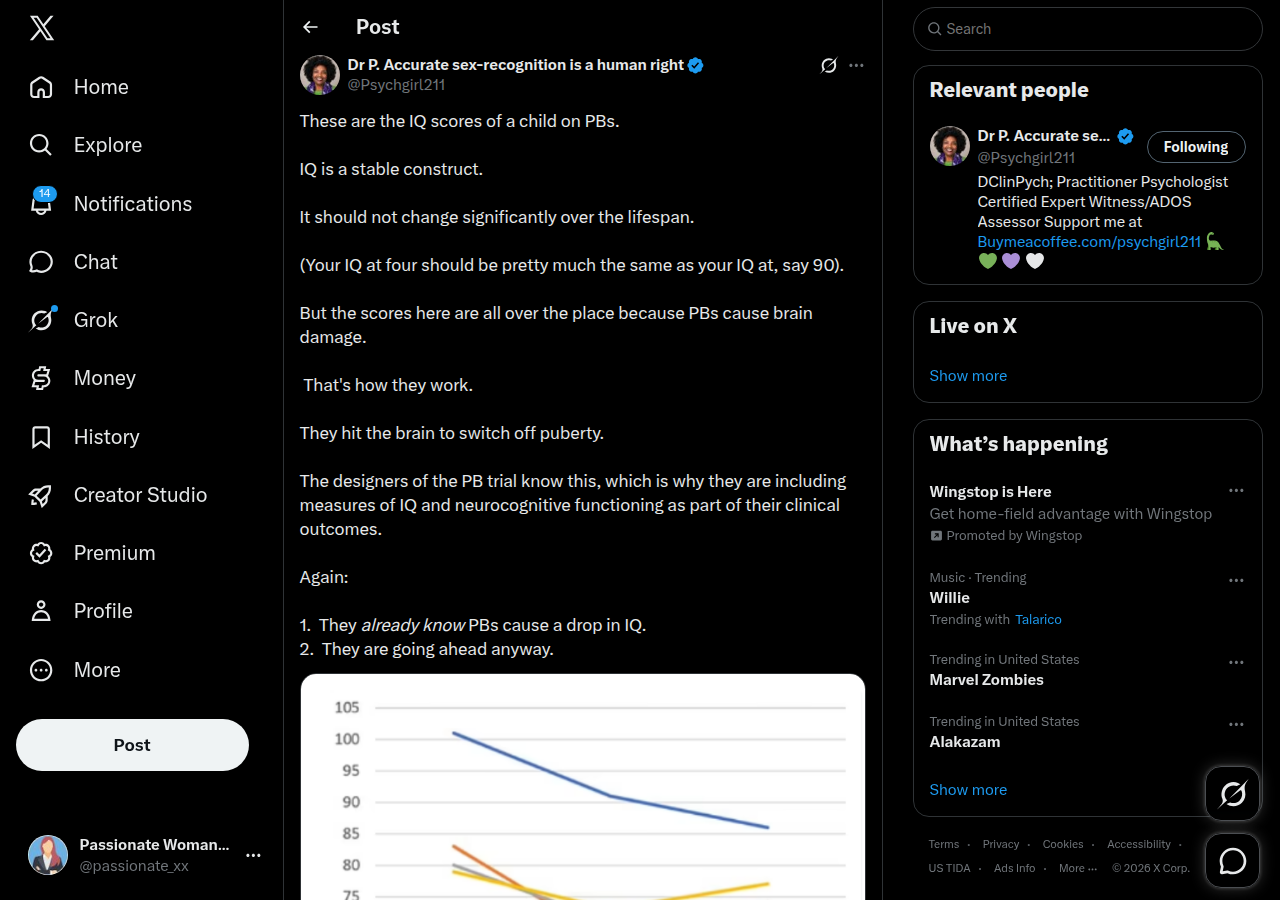
Dr. P (@Psychgirl211) shared a graph showing significant IQ score declines — across verbal comprehension, working memory, global IQ, perceptual reasoning, and processing speed — in a child tracked over approximately 2.5 years on puberty blockers.
The graph had 1,800 likes and 615 reposts. The significance: puberty is a critical developmental window for the brain. The hormones released during puberty — including sex hormones — are involved in brain maturation, bone density, and neurological development. Puberty blockers do not pause puberty neutrally. They block the hormonal cascade that drives development during a non-repeatable window.
The Cass Review, the FDA label updates for GnRH agonists (the class of drug used as puberty blockers), and multiple independent analyses have all noted that the claim that puberty blockers are "fully reversible" is not supported by evidence and may be false — particularly for neurological and cognitive development.
The fundamental unanswered question
If gender dysphoria is an inborn condition — present from early childhood, stable across time, detectable before social influence — then the following should not be possible:
- A 4,000–5,000% increase in 15 years
- A sex ratio shift from predominantly male to predominantly female
- Clustering in friendship groups and social media communities
- Near-zero incidence before social media and significant incidence after
None of these patterns are consistent with an inborn condition. All of them are consistent with a social phenomenon. The hypothesis of social contagion was never disproven — it was suppressed. The adolescents who were transitioned while the suppression was happening are now becoming detransitioners, or are living with the consequences of irreversible procedures.
Sources & References
- 1. Wesley Yang: Pseudo-medical cult practice inflicted on 12-year-olds as school/medical officials encouraged. 3.5K likes, 1.1K reposts. Rating 3
- 2. Maia Poet: 15yo tomboy bound breasts, now 25yo woman — no need for transition. Rating 2 (real personal story)
- 3. Maia Poet: SSRI meds nix libido/genital sensation, disconnecting youth from bodies → trans pipeline. Rating 3
- 4. Sam Barber: Daughter secretly given binder by school without parental consent; Mermaids binders referenced. Rating 2 (real personal story)
- 5. Mia Hughes: 1950s researchers found future homosexuals, not trans kids — set stage for conversion therapy. Rating 2 (real historical analysis)
- 6. Read Piaget: No child born believing in gender identity — social construct unlike sex. Rating 3
- 7. Julia Mason MD: Children under 8 believe adults/doctors can change their sex; we can't. Rating 3 (pediatric observation)
- 8. Travis Morrell MD: Puberty non-repeatable hormone boost for brain/bones — don't block kids' right to grow. Rating 3
- 9. Dr P: Graph showing significant IQ drops in a child on puberty blockers over ~2.5 years (verbal, working memory, global IQ, processing speed). 1.8K likes, 615 reposts. Rating 2 (real graph)
- 10. Littman L (2018). "Rapid-onset gender dysphoria in adolescents and young adults: A study of parental reports." PLOS ONE. (Republished after retraction attempt with minor revisions)
- 11. Cass Review 2024: Finds 4,000% increase in adolescent referrals to gender clinics, predominantly girls, in the UK