
Gender Dysphoria: The Clinical Reality, the Sudden Adolescent Explosion, and Why the Diagnosis Does Not Mean What Activists Claim
Gender dysphoria — the DSM-5 diagnosis for significant distress caused by incongruence between experienced gender and biological sex — is a real condition that causes real suffering. But the diagnosis has been decoupled from its clinical meaning and weaponized as political identity. The historical pattern of gender dysphoria (rare, predominantly male, emerging in early childhood) has been replaced by a new phenomenon: a 4,000% increase in adolescent girls presenting with sudden-onset dysphoria, many with no childhood history and many with clusters of similarly identifying friends. Historical data show 60–90% of gender-dysphoric children desist naturally by adulthood if not medicalized.
Gender dysphoria is a real condition. People with it suffer genuinely. Acknowledging the political distortions around the diagnosis is not a denial of that reality — it is the necessary condition for treating the condition honestly.
What Gender Dysphoria Is (DSM-5)
The DSM-5 definition of gender dysphoria requires:
- A marked incongruence between one's experienced/expressed gender and assigned gender, lasting at least 6 months
- This incongruence must cause clinically significant distress or functional impairment in social, occupational, or other important areas of functioning
Key aspects of the definition:
-
Distress is required: Simply identifying with the opposite sex, or with a non-binary identity, is not the diagnosis. The diagnosis requires that this incongruence causes significant suffering.
-
Six months minimum: The diagnosis is not valid for transient or situational distress.
-
Functional impairment: The person's ability to live their daily life is affected.
This diagnosis describes a condition that was historically rare — estimated at 1 in 10,000 to 1 in 30,000 of the population — predominantly male (male-to-female predominance), and emerging in early childhood (typically before age 6–7).
The Adolescent Explosion
From approximately 2012 to 2022, referrals to gender identity clinics in the UK, US, Canada, Australia, and other Western countries increased dramatically. More striking than the scale of the increase were the characteristics of the new presentation:
- The demographic shifted from predominantly male to predominantly female — adolescent girls now make up 70–80% of referrals at many clinics
- The age of presentation shifted from early childhood to adolescence (ages 12–16)
- Many presenting adolescents had no childhood history of gender dysphoria
- Many had clusters of friends who were also identifying as trans or non-binary
- Many had recently spent extended periods on social media platforms with heavy trans content
This pattern does not match the classical description of gender dysphoria. The historical cohort was predominantly male, cross-gender identified from early childhood, and presented at clinics with parents who had observed the pattern for years. The new cohort is predominantly female, presents in adolescence, and in many cases follows a period of intense social media engagement.
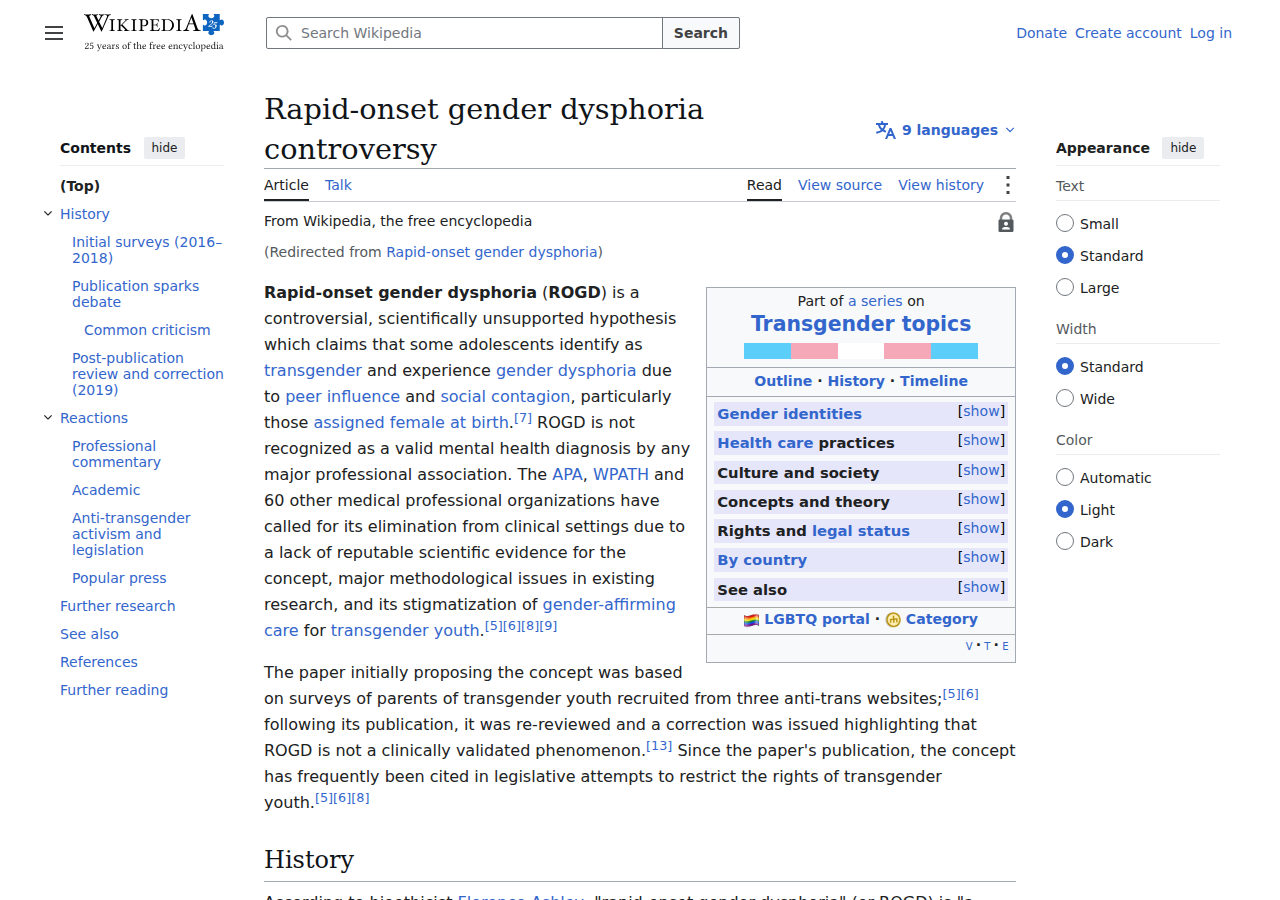
Lisa Littman's research (2018): Brown University epidemiologist Lisa Littman published a peer-reviewed study describing 'rapid-onset gender dysphoria' — a pattern in which adolescents (predominantly female) developed gender dysphoria suddenly, often following social media exposure and with peer clusters showing the same identification. The study described 256 cases reported by parents. It was subject to a sustained political attack; the Brown University press release was removed following criticism from trans advocates. The paper was subjected to a post-publication review and republished with minor corrections. Its core findings have not been refuted.
Desistance: Most Gender-Dysphoric Children Stop Identifying as Trans
Long-term follow-up studies of gender-dysphoric children — conducted before the current era of social transition and pediatric medication — consistently found that 60–90% of gender-dysphoric children desist by adulthood: they stop identifying as the opposite sex.
Wallien & Cohen-Kettenis (2008) followed 77 gender-dysphoric children; 27% persisted into adulthood. Most of the desisting children identified as gay or lesbian as adults.
Steensma et al. (2011, 2013) — additional Dutch data: of children with gender dysphoria, 80% did not persist if they had not been socially transitioned. Of those who had been socially transitioned, 98% persisted.
This last finding is crucial: social transition (changing name, pronouns, presenting as the opposite sex) is not a neutral administrative choice. It dramatically increases the probability that a child's dysphoria will persist into adulthood — either by reinforcing the identification or by making desistance socially costly. A child who has been 'Emily' at school for three years faces enormous social pressure not to detransition.
The implication: if 60–90% of gender-dysphoric children would naturally desist, and social transition and medical intervention dramatically reduce the desistance rate, then a significant number of children who are medically transitioned would not have persisted in their dysphoria if left to develop without intervention.
Detransitioners
A detransitioner is someone who medically transitioned and later returned to their biological sex identity. This population is growing — and growing specifically among the adolescent-female cohort that drives current referrals.
Publicly prominent cases:
- Chloe Cole: Began medical transition at 13, had a double mastectomy at 15, detransitioned at 16. Now an activist testifying before state legislatures about the harms of pediatric transition.
- Luka Hein: Double mastectomy at 16. Detransitioned; now active in legal proceedings against the clinic that performed her surgery.
- Jazz Jennings: Featured for years on a TLC reality show as a trans-identified child. As an adult, Jennings has described struggling with the consequences of early medical transition, including sexual dysfunction.
The medical establishment's response to detransitioners has been largely to minimize their numbers and dismiss their testimony. The Cass Review specifically noted that research on detransitioners was 'remarkably limited' given the ethical stakes of irreversible pediatric interventions.
Genspect — an international network of clinicians, parents, and detransitioners — documents the clinical reality of people harmed by rushed gender-affirmation pathways.
The Political Capture of a Clinical Diagnosis
Gender dysphoria was a clinical diagnosis for a rare condition requiring careful differential diagnosis, consideration of comorbidities, and individualized treatment. Over the course of the 2010s, it was transformed into a political identity — one that conferred:
- Legal rights (to change documents, access sex-segregated spaces and services based on self-ID)
- Institutional protections (mandatory affirmation policies in schools, workplaces, medical settings)
- Social capital in certain communities (particularly online and in progressive social networks)
The transformation created an incentive structure that did not exist when gender dysphoria was simply a rare clinical diagnosis. A teenager who identifies as trans in a school where trans identity confers social recognition, protection from bullying, and the ability to use different bathrooms is operating in a different incentive environment than a child whose gender dysphoria was observed by parents before the child entered school.
None of this proves that any individual's trans identity is inauthentic. It does prove that the diagnostic category can no longer be assumed to capture only the classical clinical population it was designed to describe.
Sources & References
- 1. Dr P (@Psychgirl211): Why "Gender Dysphoria" is a lie — a critique of how the diagnosis has been expanded
- 2. Natalya Murakhver: Back from Genspect conference; parents and detransitioners undoing WPATH damage
- 3. Matt Walsh: Do No Harm database listing 2,000 hospitals performing sex-change treatments on minors
- 4. Genevieve Gluck: Virginia Prince — the man who popularized "transgender" described erections imagining himself as a "girl"
- 5. Mia Hughes: Dr Robert Smith amputated healthy legs for BIID patients — analogy to gender surgery for body dysphoria
- 6. Lisa Littman, "Parent reports of adolescents and young adults perceived to show signs of rapid onset gender dysphoria" (2018)
- 7. Wallien & Cohen-Kettenis, "Psychosexual outcome of gender-dysphoric children" (2008): desistance rates