J.K. Rowling: Her Documented Positions vs. the "Transphobia" Accusation
J.K. Rowling is among the most publicly accused "transphobes" in the English-speaking world. She has received thousands of documented threats, had her home address published by activists, and been dropped by her literary agency. The accusation rests on characterizations of her views that her own documented statements refute. She has repeatedly and explicitly stated that she supports trans adults' right to live without discrimination. Her objections are to specific policies: self-identification replacing biological sex in law, males in female sports and prisons, and irreversible medical interventions on children. This is not transphobia — it is a policy disagreement about the real-world consequences of conflating sex with gender identity.
J.K. Rowling published her first public statement on sex and gender in June 2020. Since then she has received, by her own account, thousands of threats — many sexual and violent — had her home address published on social media multiple times, and been labeled a 'TERF' (Trans-Exclusionary Radical Feminist) by trans activists, much of the entertainment industry, and significant sections of the press. The accusation is that she hates trans people.
Her own words are the primary evidence against this characterization.
Her Stated Positions, in Her Own Words
In September 2025, after actors from the HBO Harry Potter series publicly distanced themselves from her views, Rowling listed her positions directly on X. The list:
- Sex is real, binary, and matters — particularly for the protection of women and girls
- Gender dysphoria is a real condition deserving of compassionate care
- Adults should be free to present however they wish and live their lives as they choose
- Trans-identified adults should be protected from discrimination and violence
- Children should not be medically transitioned
- Self-ID laws that replace biological sex with gender identity in law create harms for women
- Men should not compete in women's sports
- Male-born people should not be housed in female prisons
- Single-sex spaces (changing rooms, shelters, wards) should remain sex-segregated
In a February 2025 statement that circulated widely, she wrote: 'I wish trans adults well. I hope they live safely and with dignity. I won't believe they've changed sex, because they haven't. This isn't hostility — it's honesty.'
Another February 2025 statement: 'I wish trans adults safety. I genuinely do. But I don't believe they change sex. These things can both be true.'
The Original 2020 Essay
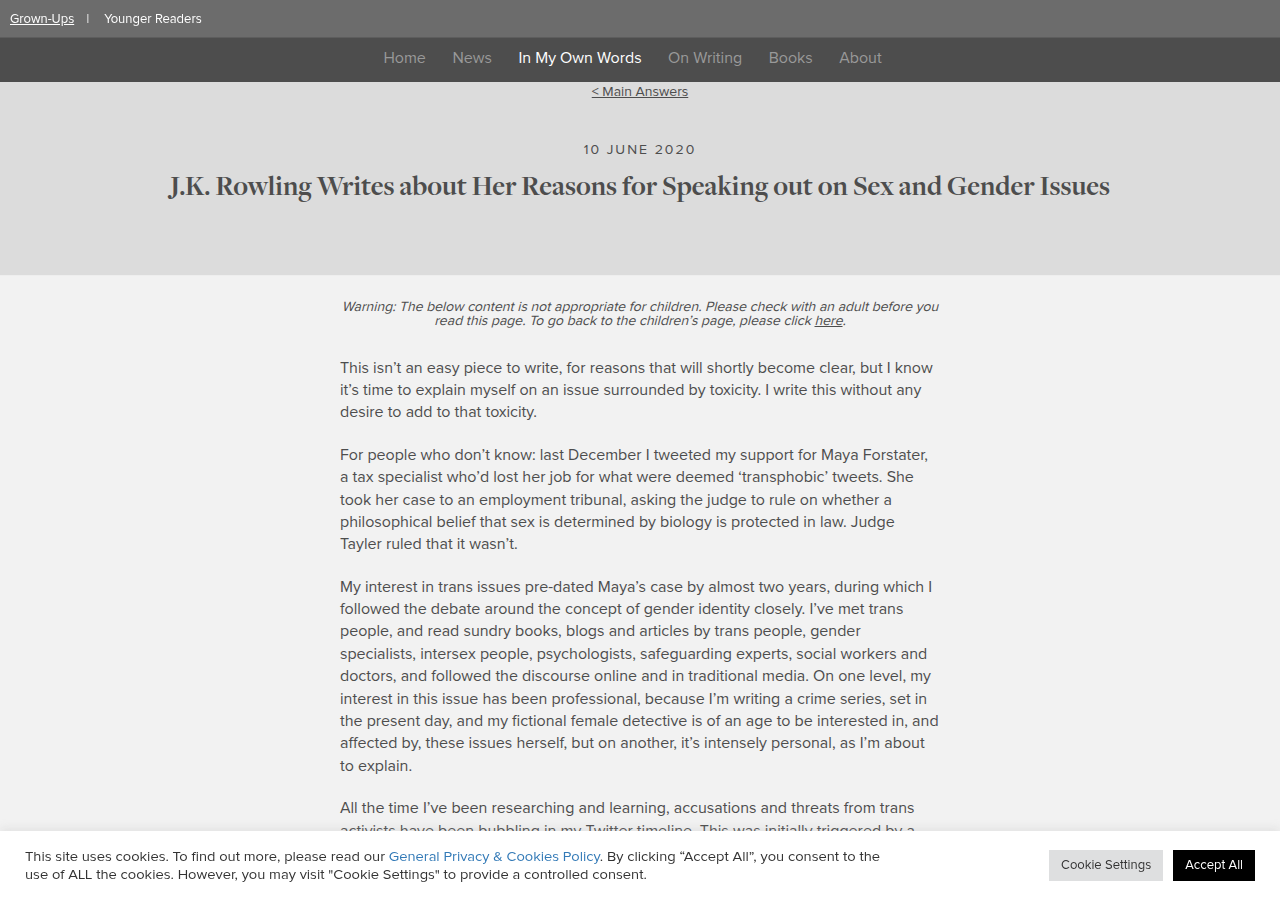
Rowling's 2020 essay — titled 'TERF Wars' by the media, though she gave it no title — runs to approximately 3,500 words and is available in full on her website. It is almost never quoted in full by those accusing her of transphobia. Its key points:
- She describes herself as a survivor of domestic abuse and sexual assault, which informs her concern about male-bodied people in female spaces
- She expresses sympathy for gender-dysphoric people and particularly for young people struggling with identity
- She expresses concern about the rapid increase in adolescent girls identifying as trans and the medical interventions being offered to them
- She distinguishes between trans adults who have carefully considered their identity and adolescents being fast-tracked to irreversible interventions
- She explicitly says she would 'march with trans people' against discrimination
The essay is patient, careful, and documented. It does not call for discrimination against trans people. It argues for the preservation of sex-based protections for women and for more caution in pediatric gender medicine.
The response included: calls to boycott her books, pressure on publishers to drop her, actors refusing to acknowledge her existence, and a sustained online campaign to associate her name with hatred.
The Cost of Speaking
Rowling has documented the consequences she has experienced for expressing these views:
- Thousands of threats, many threatening rape, murder, and violence against her children
- Her home address published by trans activists on social media — multiple times — with instructions to visit her
- Her literary agency dropped her
- Multiple actors, directors, and producers publicly refused to acknowledge her role in creating the Harry Potter universe
- Legal threats and investigations
In a 2024 statement she described the experience: 'I've watched — and participated in — the public discussion of sex and gender for five years now. I've had threats too numerous to count. My address has been posted online repeatedly with an implied invitation. My crime is believing women's sex-based rights matter.'
She has not retracted her views or apologized.
What "Transphobia" Actually Means and How It's Being Applied Here
Transphobia, used accurately, describes irrational fear of or hatred toward trans people as individuals. Applied to Rowling, it describes a person who:
- Has explicitly, repeatedly expressed support for trans adults' right to live safely
- Has never called for discrimination against trans people as a category
- Has never denied that gender dysphoria is real
- Has raised specific policy objections with documented evidence
The application of 'transphobic' to this position is not a factual description. It is a political strategy to shut down a policy debate by personalizing it as bigotry — removing the possibility of engaging with the evidence-based arguments she is making.
This is the same strategy used against others who raise concerns about specific trans-related policies: the 'transphobia' label makes the person, rather than the argument, the subject of discussion. This is not a coincidence. It is a rhetorical technique — applied against women, scientists, therapists, and journalists as well as public figures like Rowling — that functions by raising the social cost of disagreement above the threshold most people are willing to pay.
Rowling has paid that cost without retreating. Whatever one thinks of her specific positions, the characterization of her as someone who hates trans people is directly contradicted by her own documented words.
“I've read all the arguments about femaleness not being real, all the arguments that women like me are bigots, facilitators of violence, moral panickers. None of them have any effect on me whatsoever. The more I've read, the more I've come to believe that what I'm witnessing is an attack on the fundamental right of women to name their own experience.”
Sources & References
- 1. J.K. Rowling: states her full positions on sex and gender for HBO actors who disagreed with her. Rating 1 (her own verified statement)
- 2. J.K. Rowling: "I wish trans adults well but won't believe they've changed sex." Rating 1 (her own statement)
- 3. J.K. Rowling: "I wish trans adults safety, but I don't believe they change sex." Rating 1 (her own statement)
- 4. J.K. Rowling: describes thousands of threats received; address doxxed. Rating 1 (her account)
- 5. J.K. Rowling: lists her record vs a male critic including his assault conviction. Rating 1 (her own statement)
- 6. J.K. Rowling: defines illiberal, fundamentalist, totalitarian, terrorist; 144K views
- 7. J.K. Rowling: rebuts the "tiny fraction harmed" argument; lists harms. Rating 3
- 8. J.K. Rowling: "Gender identity is a fringe idea treated as settled." Rating 3
- 9. J.K. Rowling: original long-form essay "TERF Wars" (June 2020) — her full stated reasons for speaking out