
"We Only Want to Pee": The Gateway Argument, and the Documented Violations It Said Could Never Happen
The argument that was used to defeat bathroom safety bills in the United States was: "Trans people just want to use the bathroom in peace. No woman has ever been assaulted by a trans person in a bathroom." This claim — sometimes shortened to "this never happens" — was repeated in media coverage, legislative testimony, and social media throughout the 2010s. It was not true when it was made, and the documentation of incidents since then has refuted it systematically. Self-identification policies — which allow any male to enter female-designated spaces by declaring a female identity — do not screen for intent. The result is documented in police reports, court records, and institutional disclosures across multiple countries.
When US state legislatures began debating bathroom privacy bills in the 2010s — requiring that people use facilities matching their biological sex — the opposition deployed a consistent argument: trans people just want to use the bathroom in peace. No woman has ever been assaulted by a transgender person in a bathroom. You have more to fear from a lightning strike than from a trans person in a locker room.
This was the gateway argument. It framed the issue as trans safety (keeping trans people from being harassed in bathrooms) rather than female safety (keeping predatory males out of female spaces). It also made a factual claim — "this never happens" — that was testable.
It was false when it was made. The documentation since then has made the falsity systematic.
What the Argument Actually Claims
The "we only want to pee" argument contains several embedded claims:
- Trans women are women — and therefore no more threatening in female spaces than any other woman
- Trans people present no elevated risk in female-designated spaces
- The real risk is trans people being harassed in the "wrong" bathroom
- Predators don't use self-ID as cover because they have other means of accessing victims
- "This never happens" — no incidents of predatory males using trans identity as access to female spaces have been documented
Each of these claims is separable, and each of them fails contact with evidence.
The Policy Problem: Self-ID Screens for Nothing
The critical policy distinction that the gateway argument obscures is this: self-identification policies require no verification of any kind.
A policy that allows trans women — people who have undergone years of social and medical transition and live full-time as women — into female spaces is a different policy from one that allows any male who declares a female identity to enter female spaces at any moment, with no documentation, no waiting period, no gatekeeping.
Self-ID policies are the latter. They cannot distinguish between:
- A post-operative trans woman who has lived as a woman for 20 years
- A predatory male who has declared a female identity to access a target
- A male with autogynephilia whose motivation is sexual
- A male who simply wants to observe or photograph women
The "we only want to pee" argument was constructed to defend the first category. Self-ID policies apply to all four.
Documented Violations: Bathrooms, Locker Rooms, and Schools
The following incidents are documented in police reports, court records, institutional disclosures, and press coverage:
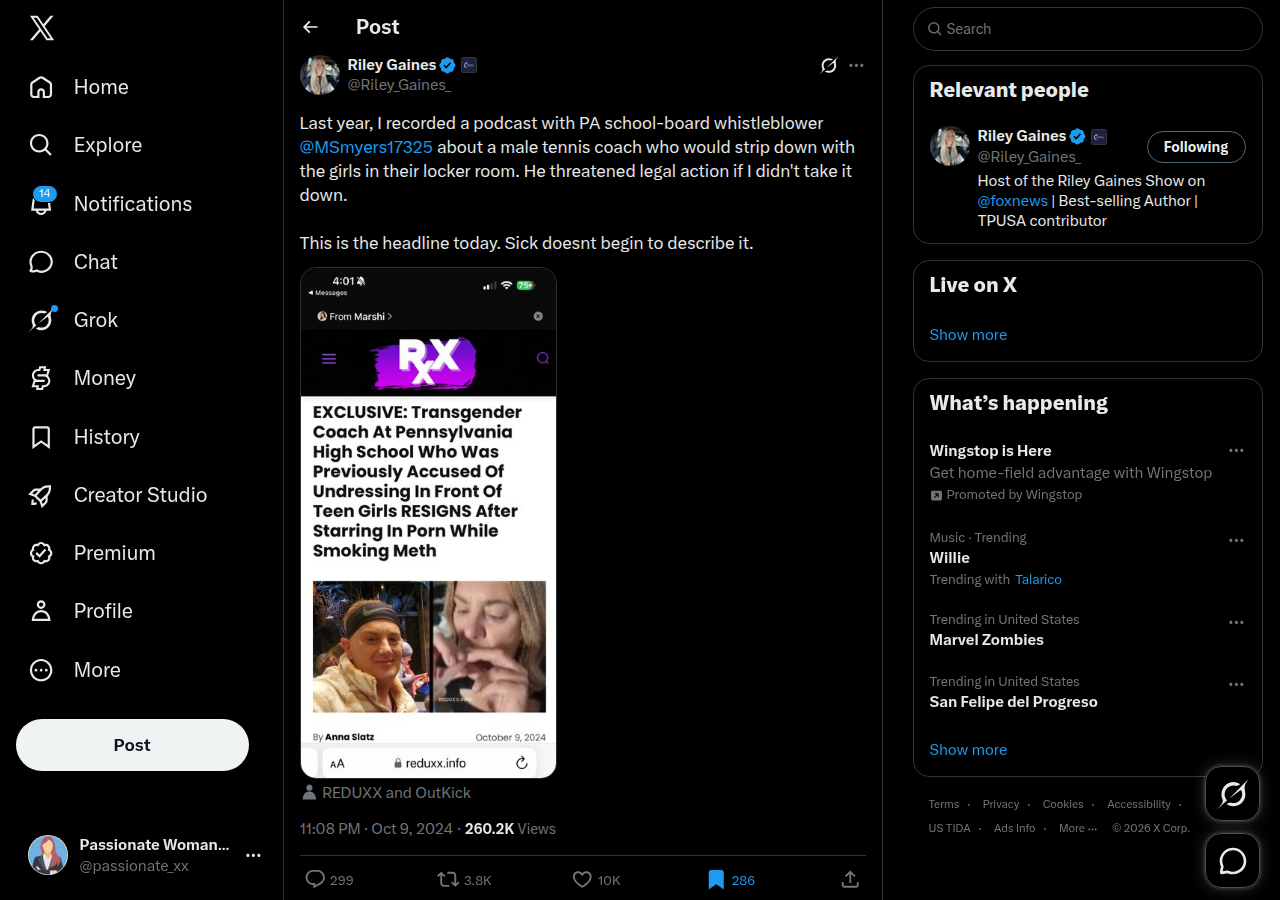
Pennsylvania, 2024 — Male coach arrested for child pornography: A male tennis coach who had been allowed to enter girls' locker rooms, including while students changed, was arrested for possession of child pornography. Riley Gaines — the swimmer who became a prominent women's sports advocate after competing against Lia Thomas — flagged the original locker room access as a safety failure; the coach threatened legal action against those who raised concerns. He was subsequently arrested. The pattern: initial access granted under a trans-protective framework, concerns raised, concerns suppressed via legal threat, eventual arrest.
Virginia — 6'1" trans-identified male attacks in school: A trans-identified male student described as 6'1" was involved in a documented school attack. Amy Sousa (@KnownHeretic), who has documented multiple such cases, noted this as "one of many" instances in which schools provide males a free pass under trans identity framing.
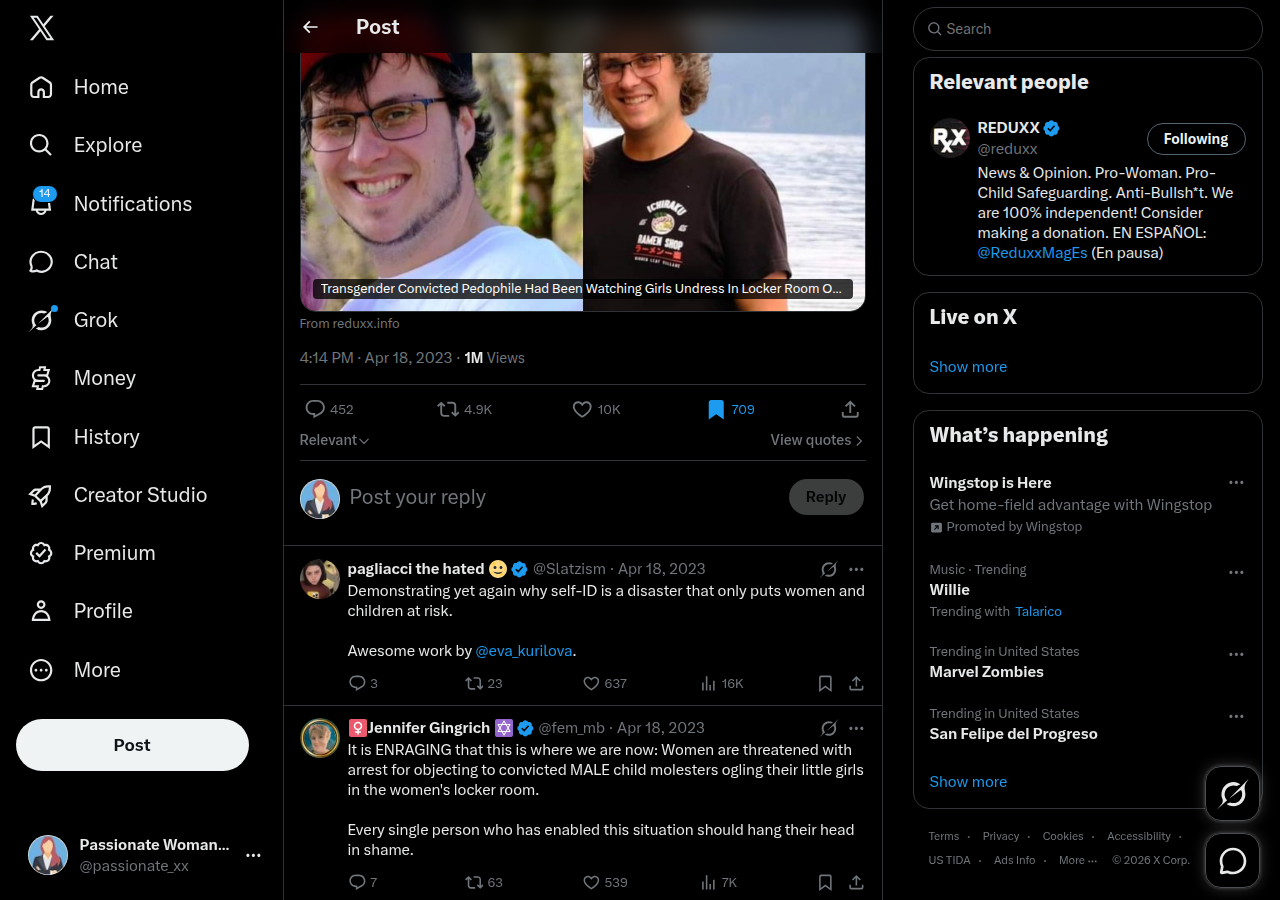
Canada — Convicted pedophile uses locker room: REDUXX, an investigative outlet covering women's issues, documented a case in which a trans-identified male who was a convicted pedophile was observed watching girls in a Canadian public pool locker room. When the mother of one of the girls reported this and raised the alarm, she was threatened with arrest. The pedophile's previous conviction had not been treated as a disqualification from female-designated spaces under the facility's self-ID policy.
California — 80+ school districts: Beth Bourne, who personally contacted over 80 California school officials, documented specific districts in California allowing males in girls' sports locker rooms and changing facilities. The pattern across her reports: administrators acknowledge the policy, decline to change it, and characterize parents raising concerns as the problem.
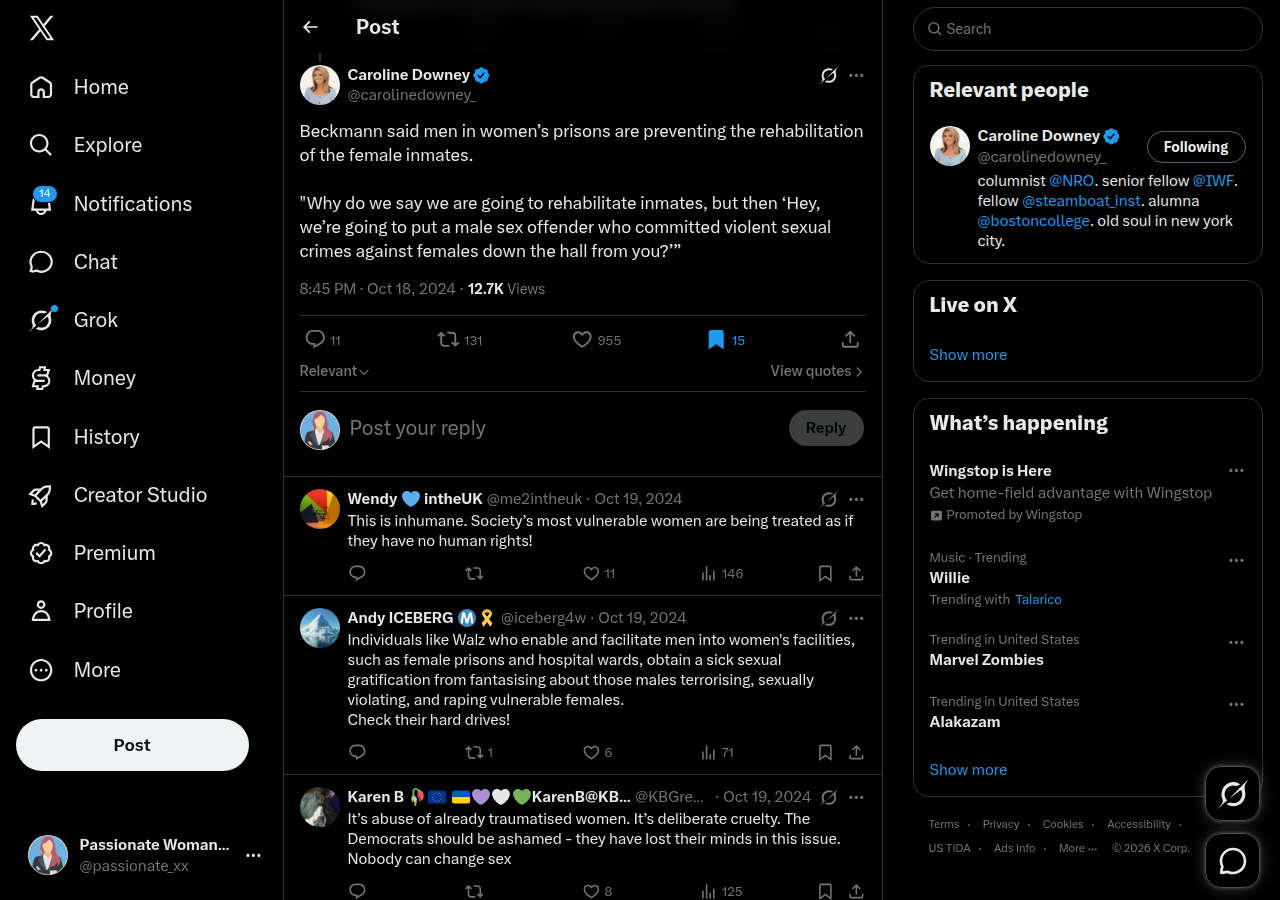
Minnesota women's prison: A teacher resigned from a Minnesota women's prison after male inmates — housed there under trans-identity policies — were, in her documented account, retraumatizing female inmates who were survivors of male sexual violence. The presence of biological males in a space specifically designed as a safe environment for female survivors of male violence produced the outcome that critics of such policies predicted.
The "This Never Happens" Pattern
The response to each documented incident follows a pattern:
- Initial denial: "This never happens / this is a rightwing fabrication"
- When the incident is verified: "This one case doesn't justify discrimination against all trans people"
- When multiple cases are documented: "The data doesn't show elevated risk" (data collection is blocked by the same policies that create the problem)
- When data is produced (UK Ministry of Justice data on trans-identified prisoners, for example): "The methodology is contested"
- Return to step 1 for the next incident
Libs of TikTok (@BobbySingular, @Bubblebathgirl et al.) compiled a collage in response to the common challenge: "Show me when a trans woman has ever assaulted someone in a bathroom." The collage contains documented cases from police reports and press coverage. The response to the collage was not engagement with the cases — it was renewed assertion that the pattern doesn't exist.
The logical structure of "this never happens"
The argument that predatory males don't use self-ID as cover because "predators have other means" is circular:
- Predators have other means → therefore they won't use this one
- This assumes predatory motivation is the primary driver
- It ignores opportunistic predation, voyeurism, and the fact that male sexual offenders are overwhelmingly opportunistic — they use the access available to them
- The argument also proves too much: by the same logic, no access-restriction policy would ever deter predation, since predators "have other means" for every policy
The real question is not whether self-ID eliminates all predation — it's whether it creates additional access that would not otherwise exist. The documented cases answer that question.
The Strip Search Problem
An underdiscussed dimension of self-ID in institutional settings is its interaction with legal obligations on opposite-sex searches.
In Quebec, prison officers documented refusing to conduct strip searches on detainees of the opposite biological sex — both male officers refusing to search biological females, and female officers objecting to being required to search biological males who identified as female. This is not a fringe concern: strip searches, pat-downs, medical examinations, and intimate physical care in institutional settings (hospitals, prisons, immigration detention) require sex-segregated staffing for dignity, consent, and anti-coercion reasons. Self-ID policies that classify biological males as female in institutional records create documented conflicts with these obligations.
“Supporting a movement telling women and children to trust a strange man, ignore their instincts, and look away from a 'female penis' aids a sex offender's paradise.”
Sources & References
- 1. Riley Gaines: Male PA tennis coach stripped in front of girls; threatened legal action when exposed; arrested for child porn. Rating 2 (real arrest)
- 2. Amy Sousa: Virginia school — 6'1" trans-identified boy one of many school attacks; schools give boys free pass under trans guise. Rating 3
- 3. REDUXX: Trans-identified male convicted pedophile watching girls in Canadian pool locker room; mother threatened with arrest. Rating 2 (real exposé)
- 4. Libs of TikTok collage: Man asks when trans woman assaulted in bathroom; LoTT response collage of real perpetrators. Rating 2
- 5. Caroline Downey: Teacher resigns from MN women's prison — male inmates retraumatizing abuse victims. Rating 2 (real story)
- 6. Beth Bourne: Spoke to 80+ CA officials — specific districts allowing males in girls' sports/locker rooms. Rating 3 (personal testimony)
- 7. TheFamousArtistBirdyRose: Women/gays attacked; justification = "trans just want to pee in peace." Rating 3
- 8. Sal Robins: Supporting movement telling women to trust strange men, ignore instincts aids sex offender's paradise. Rating 3
- 9. Heather Mason: Quebec prison officers refuse strip searches on opposite-sex detainees; provocative behavior. Rating 2 (real protest)
- 10. HeCheated.org: Advocacy site documenting males in women's sports depriving females of opportunities; case list.