Global Atrocities, Christian Persecution, and the Selective Outrage About Israel
Documenting mass killings, genocides, forced conversions, and kidnappings happening simultaneously with — or dwarfing — the Gaza conflict, while the same protesters remain silent. The data demonstrates anti-Israel bias, not humanitarian concern.
Between October 7, 2023 and mid-2024, global protest movements descended on Western cities, universities, and parliaments demanding sanctions, boycotts, and criminal prosecution against Israel — citing approximately 35,000 deaths in Gaza (the Hamas-run Gaza Health Ministry's count, which does not distinguish combatants from civilians) during an active war launched by Hamas's mass murder of 1,200 Israeli civilians.
During the same period:
- Sudan's civil war was producing estimates of tens of thousands to over 100,000 deaths, with a renewed genocide in Darfur against the Masalit people — and generating no university encampments, no major Western protest marches, no boycott movements
- Nigeria's Islamist militias and Fulani herders were killing thousands of Christians annually — no protests
- Pakistan and Egypt's Christian and Hindu girls were being systematically kidnapped, forcibly converted, and forced into marriage — no protests
- China held an estimated 1-1.8 million Uyghur Muslims in detention camps — some protests, vastly smaller than Gaza protests
- The Sahel was experiencing ongoing Islamist massacres of Christian and animist villages — no protests
This page documents the atrocities that generated no protest. The disproportion is not explainable by death toll, by legal classification, or by documentation quality — atrocities with far higher confirmed death counts, sometimes with official genocide declarations, generated a fraction of the response. The most parsimonious explanation is that the selection criterion is not humanitarian concern: it is the identity of the perpetrator and victim.
The UN Tells You Everything You Need to Know
The United Nations Human Rights Council (UNHRC) has passed more resolutions targeting Israel than any other country in the world — more than North Korea, Syria, Iran, Sudan, and China combined.
This is not a contested claim. It is a documented, verifiable institutional fact, tracked by UN Watch and Eye on the UN (Anne Bayefsky).
- North Korea: approximately 0–2 resolutions per year in typical sessions
- Syria (500,000+ deaths in its civil war): periodic resolutions, far fewer than Israel
- Iran: occasionally mentioned; far fewer binding resolutions than Israel
- Sudan (Darfur genocide, ICC-indicted head of state): addressed in far fewer dedicated resolutions than Israel
- China (1-1.8 million Uyghurs detained): the UNHRC failed to pass a motion even to debate Chinese human rights in 2022, with 19 votes for, 17 against, 11 abstentions — the first time in UN history a motion was voted down. This was after a UN report itself found China may have committed crimes against humanity in Xinjiang.
Israel: a consistent top-ranked recipient of UNHRC resolutions across its history, with a permanent agenda item (Item 7) dedicated exclusively to "the human rights situation in Palestine" — no other country or region has a permanent dedicated agenda item.
The UNHRC's composition explains part of this: it includes members with poor human rights records who vote to protect each other and target Israel. But the effect is the same: the international human rights apparatus applies a different standard to Israel than to everyone else.
The Numbers Side by Side
| Conflict / Atrocity | Est. Deaths | Period | Official Genocide Declaration? | Major Western Protests? |
|---|---|---|---|---|
| Gaza War (2023–2024) | ~35,000–44,000 (total, incl. combatants) | Oct 2023 – present | No | Massive — university encampments, millions in streets |
| Sudan Civil War (2023–2024) | 10,000–150,000+ | Apr 2023 – present | Genocide declared by UN experts for Darfur/Masalit | Minimal — small diaspora protests only |
| Darfur Genocide (2003–ongoing) | 200,000–400,000 | 2003 – ongoing | Yes — US (2004), ICC arrest warrant | Moderate (Save Darfur, 2004–07); faded |
| Nigeria: Christians killed (2009–present) | ~50,000 (advocacy est.) | 2009 – present | No | None sustained |
| Iraq: Yazidi genocide (2014) | 5,000–10,000 killed; 5,000–7,000 enslaved | 2014 | Yes — US, UK, EU, UN (2016) | Some; no sustained movement |
| Iraq Christians expelled (2003–2018) | ~1,200 → ~250,000 remaining (80% collapse) | 2003–2018 | No | None |
| China: Uyghur detention (2017–present) | 1–1.8 million in camps | 2017–present | Yes — US (2021), Canada, Netherlands | Some; much smaller than Gaza |
| Ethiopia: Tigray (2020–2022) | 100,000–500,000+ | 2020–2022 | No (ongoing investigation) | Minimal |
| DRC: ADF / IS-affiliate (ongoing) | 100,000+ over group's history | 1990s–present | No | None |
| Sahel: JNIM/IS (2012–present) | 20,000–50,000+ | 2012–present | No | None |
| Myanmar: Rohingya (2016–2017) | 10,000–25,000 killed; 700,000+ displaced | 2016–2017 | Yes — UN, ICC investigation | Some; much smaller than Gaza |
| Syria Civil War (2011–ongoing) | 500,000+ | 2011–present | No | Some early; faded |
| Yemen Civil War (2015–ongoing) | 377,000+ | 2015–present | No | Minimal |
Gaza death figures: Gaza Health Ministry (Hamas-run); do not distinguish combatants from civilians. For context: in typical urban warfare against a group with 40,000+ fighters embedded in civilian infrastructure, combatant deaths are typically a significant fraction of total deaths.
Deaths in Sudan, Nigeria, DRC, Sahel are harder to count because journalists and investigators have restricted access — these figures are underestimates.
Sudan: A Genocide the World Is Ignoring
The Current War (April 2023–present)
On April 15, 2023, the Sudanese Armed Forces (SAF) and the Rapid Support Forces (RSF) went to war. The RSF is the direct institutional successor to the Janjaweed militias — the Arab militia responsible for the original Darfur genocide of 2003–2010.
West Darfur — the Masalit massacre: In 2023, the RSF conducted systematic attacks on the Masalit people — a non-Arab Black African group — in West Darfur, particularly in El Geneina. UN human rights investigators and independent researchers used the word "genocide" to describe the RSF's conduct. The targeting was explicitly ethnic: Masalit men were executed; women and girls were subjected to mass rape as a weapon of war.
Scale:
- Death toll: estimates range from 10,000–20,000+ direct deaths (UN/NGO estimates for 2023 alone) to 50,000–150,000+ when accounting for disease, starvation, and indirect mortality in a collapsed healthcare system. Precise figures are unavailable because the RSF has blocked international access to affected areas.
- Displacement: over 8 million people internally displaced and 2–3 million more as refugees in Chad, Egypt, South Sudan — making Sudan the world's largest displacement crisis as of 2024 (UNHCR/OCHA).
- Rape: UN reports and investigative journalism document mass rape as a systematic weapon. UNFPA estimates the scale in the hundreds of thousands of women affected.
Why you haven't heard much about it: No embedded journalists. Restricted access. No Western military involvement. No livestreaming from the perpetrators. The perpetrators are not a Jewish state.
Source: ACLED, UN OCHA, UN Independent International Fact-Finding Mission for Sudan (2023), Human Rights Watch, Amnesty International.
The Original Darfur Genocide (2003–ongoing)
The false belief being addressed in this conflict: "Darfur was a humanitarian crisis; it wasn't a genocide."
What the record shows:
- September 9, 2004: Secretary of State Colin Powell testified before the US Senate Foreign Relations Committee and declared Darfur a genocide — the first time a sitting US official applied the term to an ongoing conflict. US Congress passed a resolution concurring.
- March 4, 2009 and July 12, 2010: The International Criminal Court issued two arrest warrants for President Omar al-Bashir — the first sitting head of state ever indicted by the ICC. Charges included genocide, war crimes, and crimes against humanity. (The genocide charges were specifically for his intent to destroy the Fur, Masalit, and Zaghawa ethnic groups.)
Death toll: 200,000–400,000. The range reflects methodological differences in mortality studies, not denial of the event. The Darfur conflict has never ended; the RSF's 2023–2024 campaign is a continuation by the same forces.
Displacement: approximately 2.5 million people displaced at the peak of the 2003–2010 crisis.
The response: The "Save Darfur" campaign generated some Western activism (2004–2007) — the closest analogue to the Gaza protest movement but significantly smaller, shorter-lived, and focused on UN resolutions rather than boycotts of Sudan's trade partners.
Christian Persecution in Sudan
Sudan was declared an Islamist state in 1989 under President Omar al-Bashir. Sudan's constitution mandated sharia law as the basis of legislation.
- Open Doors World Watch List: Sudan consistently ranks among the top 5 countries globally for Christian persecution
- Documented: demolition of churches; arrest of pastors on blasphemy charges; deportation of foreign Christian workers; forced conversion of Christian women and girls in conflict zones
- South Sudan: The decades-long civil wars between Sudan's Arab-Muslim north and Christian/animist south (1955–1972; 1983–2005) killed an estimated 1.5–2.5 million people — a conflict that rarely generates the level of Western discussion assigned to the Arab-Israeli conflict
- Sources: Open Doors World Watch List 2024; CSW (Christian Solidarity Worldwide); USCIRF Annual Report 2024
Nigeria: The World's Deadliest Country for Christians
Open Doors estimates that Nigeria consistently suffers the highest absolute number of Christians killed annually of any country in the world. Two separate threats operate simultaneously.
Boko Haram and ISWAP
Boko Haram (whose name roughly translates as "Western education is forbidden") launched its insurgency in 2009. Its 2016 split produced ISWAP (Islamic State West Africa Province).
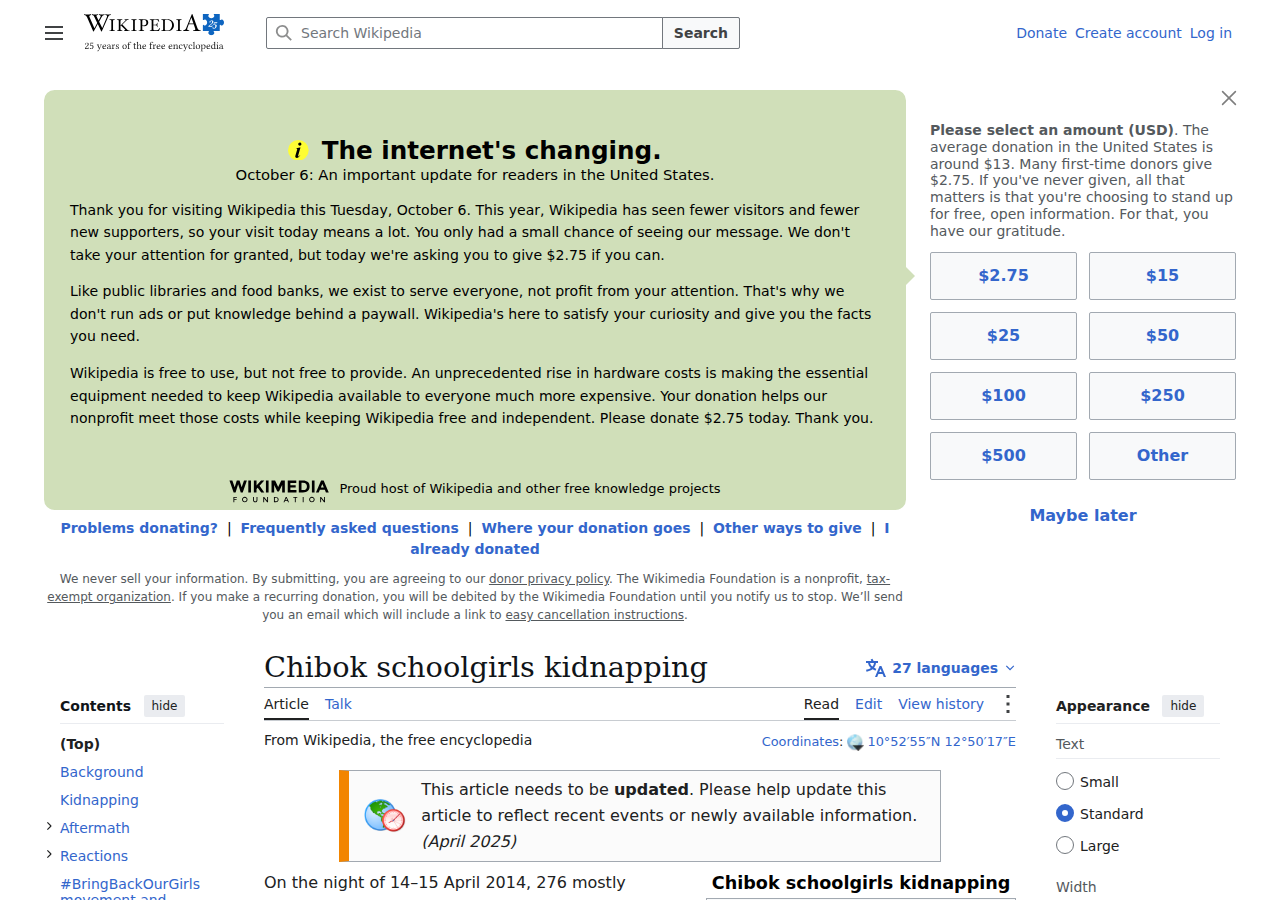
The Chibok schoolgirls kidnapping:
- Date: Night of April 14–15, 2014
- Location: Government Girls Secondary School, Chibok, Borno State
- Number taken: 276 girls initially; 57 escaped within hours; 219 taken into captivity
- Who they were: Predominantly Christian girls from the Chibok community
- What happened: Most were subjected to forced marriage and forced conversion to Islam. Some were released through negotiations in 2016 and 2017. As of the latest available information, over 100 remain unaccounted for — now in their mid-twenties if alive.
- #BringBackOurGirls: The campaign generated a brief global moment in 2014, including a photograph of Michelle Obama holding a sign. Attention faded within weeks. No boycott movement. No sustained university campaigns. No encampments.
Death toll (Boko Haram/ISWAP, 2009–present): Estimated 35,000–40,000 killed, with Christians disproportionately targeted in attacks on churches, Christian villages, and Christian schools. Source: ACLED, UN.
Fulani Militant Attacks on Christian Villages
A separate and, by some measures, more lethal threat: predominantly Muslim Fulani herders, pushed south by Saharan desertification, have been systematically attacking Christian farming communities in Nigeria's Middle Belt.
Primary affected states: Plateau, Benue, Kaduna, Zamfara, Taraba
Pattern: Villages attacked at night or during church services; homes burned; people shot or hacked with machetes; churches destroyed; farmland seized.
Scale:
- June 2018: A wave of attacks across Plateau State killed approximately 200–250 civilians in a single night; entire villages were burned
- Open Doors, Jubilee Campaign, and ACN (Aid to the Church in Need) have cited cumulative deaths in the tens of thousands
- USCIRF has recommended Nigeria be designated a Country of Particular Concern (CPC) for years; the US State Department has resisted this designation — itself a noted controversy
Source: Open Doors World Watch List 2024 (Nigeria ranked 6th globally for Christian persecution); USCIRF Annual Report; ACLED.
Pakistan and Egypt: The Kidnapping and Forced Marriage of Christian Girls
Pakistan
The pattern: A Christian or Hindu girl — often a teenager or younger — is abducted, typically by a neighbor or acquaintance. She is "converted" to Islam, often through coercion or paperwork filed without her knowledge. She is then "married" to her abductor. When her family seeks legal recourse, courts accept the conversion and marriage as valid, leaving them with no legal remedy.
Scale: The NCJP (National Commission for Justice and Peace, Catholic Church in Pakistan) has documented approximately 1,000 cases annually — though exact figures are disputed, and the true number is likely higher because many families don't report for fear of blasphemy accusations.
The blasphemy law: Pakistan Penal Code Section 295-C mandates the death penalty for blasphemy against the Prophet Muhammad. The law is disproportionately applied against Christians, Ahmadis, and Hindus. Even acquittals lead to mob violence — making the legal system a tool of communal persecution.
Notable cases:
- Asia Bibi (Aasia Noreen): Christian farmworker accused of blasphemy in 2009 after a dispute over sharing a water cup. Sentenced to death. Spent 9 years on death row. Acquitted by Pakistan's Supreme Court in October 2018. Her acquittal sparked riots; she had to flee to Canada in 2019.
- Shagufta Masih and Shafqat Emmanuel: Christian couple sentenced to death for allegedly sending blasphemous text messages. Both are illiterate. After years on death row, their sentences were eventually overturned after international pressure.
- Maira Shahbaz: Teenage Christian girl abducted in 2020, forcibly converted and "married." Her case attracted international attention; she eventually fled Pakistan.
Sources: USCIRF Annual Report (Pakistan designated a Country of Particular Concern every year); HRW Pakistan; NCJP; Open Doors (Pakistan ranked top 7 globally).
Egypt — The Coptic Christians
Egypt's Coptic Christian community (approximately 10–15 million, roughly 10% of the population) is one of the world's oldest Christian communities, predating Islam. It is also one of the most persecuted.
Palm Sunday 2017 bombings (April 9, 2017):
- Two coordinated ISIS bombings: St. George's Church in Tanta and St. Mark's Cathedral in Alexandria (where Pope Tawadros II was present but survived)
- Total killed: approximately 45–47 people
- ISIS claimed responsibility
- Response: vigils in Egypt; minimal Western protest outside of the Christian community
Forced conversion of Coptic girls:
- A systematic pattern documented by EIPR, ACN, Open Doors, CSW, and USCIRF: Coptic girls abducted, "converted," and "married" — the same pattern as Pakistan
- The Egyptian government does not publish data; advocacy organizations estimate hundreds of cases annually
- Local courts and police have been documented as complicit — refusing to act, accepting conversions, and returning girls to captors
The 2013 church attacks:
- In a single week in August 2013, following the military ouster of Muslim Brotherhood President Mohamed Morsi, approximately 40+ Coptic churches were attacked, burned, or looted. This remains one of the most concentrated waves of church destruction in the modern era.
- International response: minimal
Sources: USCIRF Annual Report 2024; Coptic Solidarity; ACN; Open Doors; EIPR (Egyptian Initiative for Personal Rights).
Iraq and Syria: The ISIS Genocides of Yazidis and Christians
The Yazidi Genocide (2014)
August 3, 2014: ISIS launched its assault on Sinjar (Shingal) district in northern Iraq — the ancient homeland of the Yazidi people, a pre-Islamic religious minority. Yazidis have lived in northern Iraq for millennia. ISIS declared them "devil worshippers" — a false characterization of their faith — and announced their enslavement was theologically mandated.
What happened:
- Yazidi men and older women: massacred. Estimates of 5,000–10,000 killed
- Yazidi women and girls: approximately 5,000–7,000 taken as slaves (sex slaves, domestic slaves). ISIS published its own theology justifying this in its magazine Dabiq. Girls as young as 9 were sold at slave markets in Mosul and Raqqa, with prices published in ISIS documents.
- 400,000+ Yazidis fled to Mount Sinjar; tens of thousands were trapped without food or water on the mountain. This siege prompted the initial US airstrikes in August 2014.
- By 2021, approximately 200,000–300,000 Yazidis remained displaced. Many women escaped but live with severe trauma; some are still held as of the latest available information.
Official genocide recognition:
- August 3, 2016: UN Commission of Inquiry declared genocide
- February 2016: UK House of Commons declared genocide
- March 17, 2016: Secretary of State John Kerry declared genocide — applying the term to ISIS's actions against Yazidis, Christians, and Shia Muslims
- European Parliament, Canada, Australia: passed genocide resolutions
Nadia Murad, a Yazidi survivor who escaped ISIS slavery, was awarded the Nobel Peace Prize in 2018. The Nobel Committee said it was to draw attention to the use of sexual violence as a weapon of war. It drew significant media attention. It did not generate a sustained protest movement demanding sanctions on ISIS's state sponsors.
Source: UN Commission of Inquiry, 2016; US Secretary of State designation; Nadia Murad, The Last Girl (2017); Yazidi Genocide Research Centre.
The Annihilation of Iraq's Christian Community
Before the 2003 US invasion: Iraq had approximately 1.4–1.5 million Christians — Assyrian, Chaldean, and Syriac communities whose history in Mesopotamia predates Islam by centuries.
By 2018: An estimated 200,000–300,000 remained — a decline of approximately 80%.
The 2014 ISIS expulsion:
- July 2014: ISIS seized Mosul, Iraq's second-largest city. It issued a notice to Mosul's Christian community: convert, pay the jizya (Christian tax), leave, or be killed. The community chose to leave. For the first time in approximately 1,900 years, Mosul had no Christians.
- The Nineveh Plain — the ancestral homeland of Assyrian and Chaldean Christians, with communities that predate the Islamic conquest by over 600 years — was ethnically cleansed.
- Churches that had stood for over a millennium were destroyed or converted to mosques.
What happened to the survivors: Most fled to Kurdistan, Europe, Australia, or the United States. The Nineveh Plain has seen some partial return since ISIS's defeat, but the community is a shadow of what it was.
Western response: Minimal protest. Some religious organizations raised funds. The collapse of one of the world's oldest Christian communities — a community contemporary with the early church — generated less sustained Western activist attention than the two-week siege of a city in Gaza.
The Sahel and DRC: Ongoing Massacres the World Doesn't Protest
Burkina Faso, Mali, Niger (Sahel):
JNIM (Jama'at Nusrat al-Islam wal-Muslimin, Al-Qaeda affiliate) and IS Sahel have operated across the Sahel since 2012, killing thousands annually in attacks on Christian villages, animist communities, and secular Muslims.
- Burkina Faso became the epicenter by 2022–2023: thousands killed per year (ACLED data); approximately 2 million internally displaced as of 2023; churches burned in northern and eastern Burkina Faso
- Mali and Niger: hundreds killed annually; entire Christian and animist communities expelled from northern and central regions
- Regional total since 2012: estimated 20,000–50,000+ deaths across the Sahel
DRC — Allied Democratic Forces (ADF/IS):
The ADF is an Islamist group that originated in Uganda in the 1990s, has operated in eastern DRC (North Kivu, Ituri) ever since, pledged allegiance to ISIS in 2019, and systematically targets Christian villages — often attacking on Sundays during church services.
- Deaths attributed to ADF over the group's history: some estimates exceed 100,000 when the full period is considered
- Annual deaths (2021–2024): hundreds to low thousands per year
- The broader eastern Congo conflict has produced an estimated 3.8–5.4 million deaths in the First and Second Congo Wars (1996–2003) and millions more in the subsequent two decades of insurgency
Source: ACLED; Kivu Security Tracker; UN Group of Experts on the DRC; Open Doors.
China: 1–1.8 Million Muslims in Concentration Camps
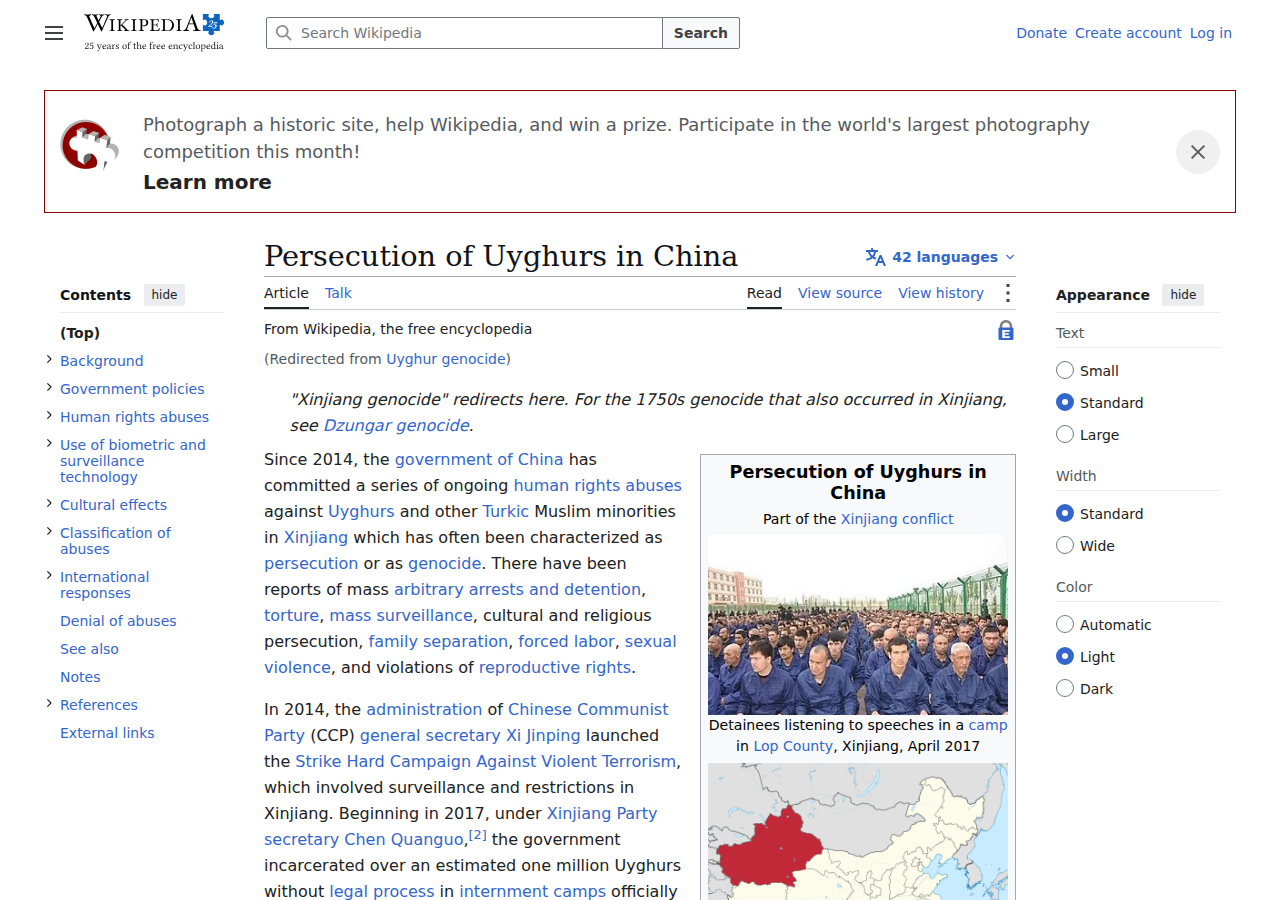
The Chinese government has detained an estimated 1–1.8 million Uyghur Muslims in what it calls "vocational training centers" in Xinjiang province.
Evidence:
- Satellite imagery (ASPI, Australian Strategic Policy Institute): documented systematic camp construction
- The Xinjiang Police Files (leaked 2022, authenticated by BBC and others): internal Chinese police documents, photographs, orders to "shoot on sight" for escape attempts, and evidence of the detention system's design
- Leaked Chinese government directives ordering officials to "round up everyone who should be rounded up"
- Documented: forced sterilization programs (documented birth rate decline in Xinjiang inconsistent with natural trends), destruction of mosques and Islamic architecture, separation of children from families, suppression of Uyghur language and religion
Official genocide declarations:
- January 19, 2021: Secretary of State Mike Pompeo declared genocide and crimes against humanity
- February 2021: Secretary of State Antony Blinken maintained and reaffirmed the genocide designation
- Canada, Netherlands, Belgium, France parliaments: passed genocide resolutions
The UNHRC failure: In October 2022, the UNHRC voted on whether even to debate China's human rights situation in Xinjiang — after the UN's own Office of the High Commissioner for Human Rights released a report finding China may have committed crimes against humanity. The vote: 19 for, 17 against, 11 abstentions. The motion failed. China had lobbied member states; African and Islamic-majority member states largely voted against. The UNHRC could not bring itself to discuss what its own investigators had documented. This is the same body that has a permanent agenda item dedicated to Israel.
Source: ASPI; Xinjiang Police Files (BBC); US State Department; Adrian Zenz academic research; UN OHCHR Xinjiang assessment (August 2022).
Historical Genocides and Mass Atrocities: The 50-Year Record
| Atrocity | Perpetrator | Victims | Deaths | Period | Int'l Response |
|---|---|---|---|---|---|
| Armenian Genocide | Ottoman Empire | Armenian Christians (+ Assyrians, Greeks) | 600,000–1.5 million | 1915–1923 | Recognized by US (2021), France, Germany, Canada; Turkey denies |
| Bangladesh Liberation War | Pakistani Army | Bengali Hindus + secular Bengalis | 300,000–3 million (highly disputed; Bangladesh: 3M; academics: 300K–500K) | 1971 | US (Nixon/Kissinger) backed Pakistan; India intervened; "Blood Telegram" by US diplomat Archer Blood documented the atrocity |
| Cambodian Genocide | Khmer Rouge (Pol Pot) | Educated Cambodians, ethnic Vietnamese/Chinese, Cham Muslims, Buddhists, Christians | 1.5–2 million (25% of population) | 1975–1979 | Minimal during killing; Vietnam's invasion ended it; ECCC tribunal decades later |
| East Timor | Indonesian military | Catholic/Christian East Timorese | 100,000–180,000 (25–30% of population) | 1975–1999 | US and Australia acquiesced during Cold War; Santa Cruz massacre (1991) catalyzed attention; independence 2002 |
| Darfur | Sudan (Janjaweed/RSF) | Non-Arab Black Africans (Fur, Masalit, Zaghawa) | 200,000–400,000 | 2003–ongoing | US genocide declaration (2004); ICC indictment of al-Bashir; moderate activism; faded |
| Rwanda | Hutu extremists (Interahamwe) | Tutsi minority + moderate Hutus | 500,000–800,000 | 100 days in 1994 | UN peacekeepers present but blocked from intervening; US avoided the word "genocide"; intervention came too late |
| Srebrenica/Bosnia | Bosnian Serb forces | Bosniak Muslims | 8,000 (Srebrenica); 97,000–104,000 total war | 1992–1995 | NATO intervened belatedly; ICTY convictions; Karadzić and Mladić convicted of genocide |
| Yazidi genocide | ISIS | Yazidis (Iraq) | 5,000–10,000 killed; 5,000–7,000 enslaved | 2014 | US, UK, EU declared genocide 2016; some military intervention against ISIS |
| Uyghur detention | China | Uyghur Muslims | 1–1.8 million in camps | 2017–present | US genocide declaration 2021; UNHRC blocked from debating it |
Note: Several of these atrocities involved Muslim victims (Bosnia, Rwanda's Muslim victims, Uyghurs, Rohingya). The point is not anti-Muslim — it is that all of these generated less international protest per death than Gaza, and several involve atrocities committed against Muslims by non-Israeli actors with little Western pressure.
What the Selective Outrage Demonstrates
The argument from proportionality:
If the Gaza protest movement were driven by:
- Death toll: Sudan, Congo, Darfur, Nigeria, Yemen, and Syria all have higher confirmed deaths — many with official genocide designations — and generated no comparable protest movement
- Civilian targeting: ISIS systematically enslaved and executed civilians as documented policy, with its own published theology justifying it. Generated no campus encampments.
- Detention without trial: China holds 1–1.8 million Uyghurs. Generated some protests, vastly smaller.
- Forced conversion of women and girls: Systematic in Pakistan, Egypt, Sudan, Nigeria. Generated essentially no Western activist response.
- Displacement: Sudan produced the world's largest displacement crisis as of 2024. Generated minimal response.
- Humanitarian access blocked: The RSF has blocked aid access in Sudan. The Israeli government has been condemned for the same; Sudan has not.
The Matti Friedman observation (former AP journalist, 2014): Friedman documented that the international press corps dedicates more resources to Israel-Palestine than to any conflict with equivalent or higher death tolls. The AP's Jerusalem bureau, he noted, had more journalists than its entire India bureau — a country of 1.4 billion people. He attributed this not to editorial conspiracy but to audience interest and institutional habit — both of which reflect assumptions about which deaths matter.
The UNHRC data is the clearest single demonstration: the institution responsible for international human rights has voted, repeatedly and measurably, that Israeli actions deserve more formal condemnation than genocides, mass detentions, and ongoing massacres in Africa and Asia.
The counter-argument: Some argue Israel receives disproportionate attention because:
- It receives US military aid (~$3.8 billion/year), making it directly relevant to Western citizens
- Media access to Gaza is/was available in ways that Sudan or DRC are not
- The conflict has a 75-year documented history with a UN-recognized prior status
These are legitimate methodological points. They do not explain why the same protest infrastructure — the universities, the NGOs, the social media networks — has never generated comparable sustained action on Darfur, on Sudan's current genocide, on the Chibok girls, on the Yazidis, on the Pakistani Christian girls.
The parsimonious explanation: When protesters are willing to march for Palestinian civilians killed in warfare by Israel but not for:
- Masalit civilians killed in genocide by Arab militias
- Yazidi women enslaved by ISIS
- Nigerian Christian girls kidnapped by Boko Haram
- Pakistani Christian girls forcibly converted by their communities
- Uyghur Muslims held in concentration camps
...the selection criterion is not civilian deaths. It is not religious persecution. It is not even displacement or humanitarian catastrophe. The selection criterion is: Israeli perpetrator.
This is, by definition, the application of a different standard to Jewish-perpetrated actions than to identical or worse actions by other actors. That is antisemitism. It may be antisemitism without conscious hatred of Jews — systemic, structural, embedded in activist culture — but it is antisemitism nonetheless.
Sources
Databases and monitoring organizations:
- ACLED (Armed Conflict Location and Event Data Project) — real-time conflict and atrocity tracking
- Open Doors World Watch List — annual ranking of Christian persecution by country
- USCIRF Annual Report — US Commission on International Religious Freedom
- UN Watch — UN human rights council resolution tracking
- Eye on the UN — Anne Bayefsky's documentation of UNHRC bias
- Kivu Security Tracker — eastern DRC conflict data
- Genocide Watch — genocide risk assessments
Official designations:
- ICC: al-Bashir Arrest Warrants — ICC documentation of Darfur genocide charges
- US Secretary of State: ISIS Genocide Designation — John Kerry, March 17, 2016
- US State Department: Uyghur Genocide Declaration — 2021
- UN OHCHR Xinjiang Assessment (2022)
Journalism and scholarship:
- Matti Friedman, "An Insider's Guide to the Most Important Story on Earth," The Atlantic, August 2014
- Douglas Murray, The War on the West (2022); The Strange Death of Europe (2017)
- Nadia Murad, The Last Girl (2017) — first-person Yazidi genocide account
- Naomi Oreskes, Merchants of Doubt (cross-referenced: how attention to evidence is manufactured)
- ASPI Xinjiang Data Project — satellite imagery of Uyghur camps
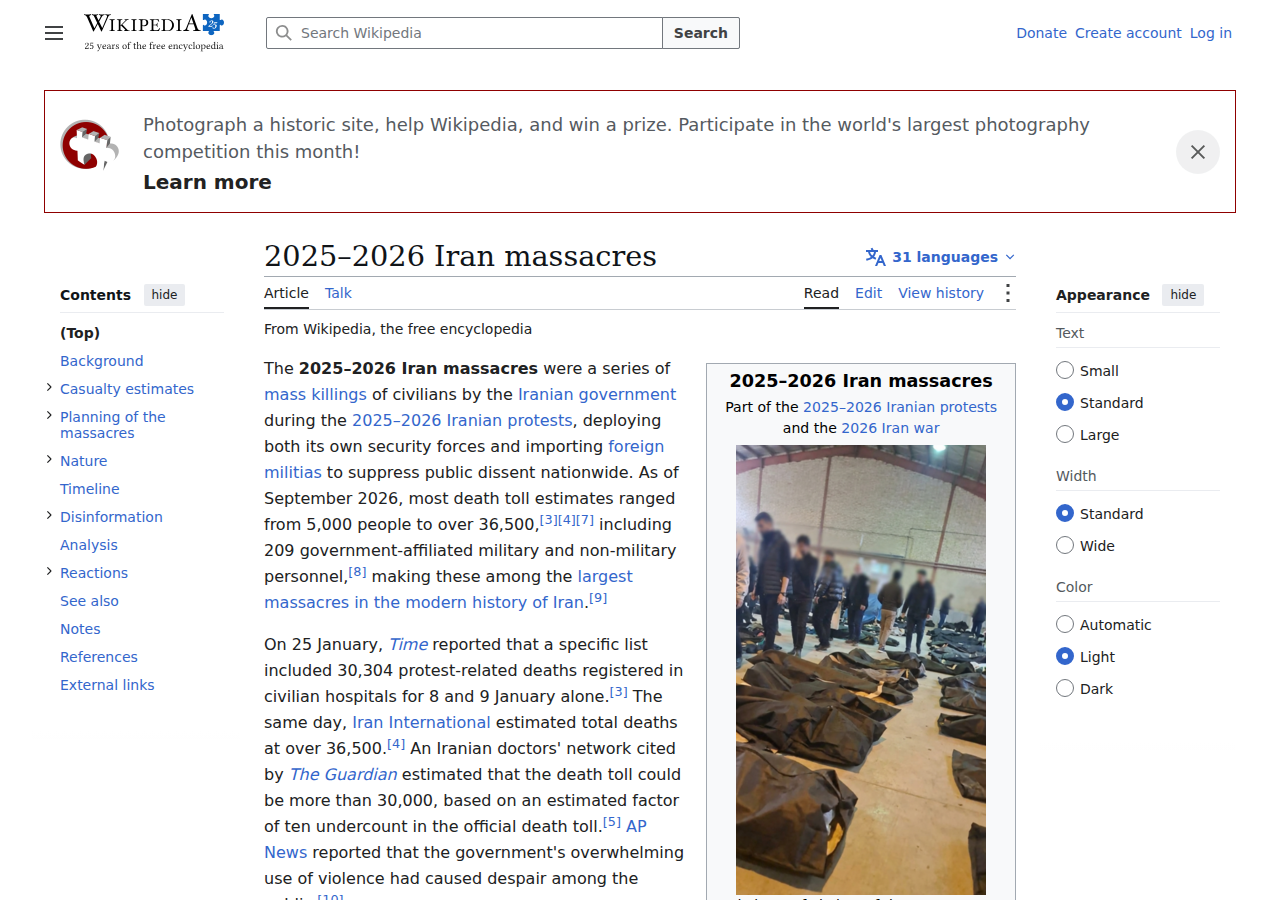
Iran's 2025–2026 Massacres: The IRGC's War Against Its Own People
Background:
On December 28, 2025, merchants in Tehran's Grand Bazaar closed their shops in protest over a collapsing currency and soaring inflation. Within days, spontaneous protests erupted across all 31 Iranian provinces — in approximately 200 cities and towns — as ordinary Iranians demonstrated against economic mismanagement and the clerical regime.
These were not armed insurgents. They were not directed by a foreign power. They were shopkeepers, workers, students, and families, protesting peacefully.
The Massacre:
Between December 30, 2025 and March 31, 2026, Iranian security forces — primarily the IRGC and Basij, supplemented by imported foreign militias including an estimated 5,000 Iraqi Popular Mobilization Force fighters, Hezbollah units, and Afghan Shia militias (Liwa Fatemiyoun, Liwa Zainabiyoun) — carried out mass killings across the country.
The most intensive killing occurred over two consecutive nights: January 8–9, 2026. Iran International estimated at least 12,000 people were killed in those 48 hours alone.
Death toll estimates by source:
| Source | Estimate | Date of estimate |
|---|---|---|
| Iranian government | 3,117 | February 2026 |
| HRANA (Human Rights Activists in Iran) — verified | 7,007 | February 2026 |
| Reuters | at least 5,000 verified | January 18, 2026 |
| Iran International | 36,500+ | January 25, 2026 |
| International Centre for Human Rights | 43,000 | January 20, 2026 |
| Guardian (medical sources) | over 30,000 | January 27, 2026 |
The full-period cumulative toll through March 2026 has been estimated by human rights organizations at upward of 50,000, accounting for ongoing killings, deaths from injuries, and executions of detained protesters. The Iranian government imposed a near-total communications blackout — internet was severed on January 8, with military-grade jamming of Starlink terminals — which suppressed documentation and inflated the gap between government figures and independent estimates.
Command authority: Supreme Leader Ali Khamenei publicly called protesters "rioters" who should be "put in their place" on January 3. Internal communications, cited by The Guardian, indicate orders from Khamenei and the Supreme National Security Council to "crush protests by any means necessary." The three branches of the Iranian government approved the crackdown operation.
Tactics used:
- Snipers with live fire, with documented orders to target heads, eyes, and vital organs
- Heavy machine guns deployed against crowd concentrations
- IRGC raids on hospitals to arrest and execute injured protesters (documented in Ilam, Tehran, Rasht)
- Unidentified chemical agents (personnel in hazmat suits observed)
- Mass graves to conceal bodies; families charged for the cost of bullets used to kill their relatives
- 24,669+ arrested by January 18; coerced televised confessions broadcast
- At least 52 protesters executed by the state between January 5-14; minors included
- 160+ students killed; 236 minors documented in death lists
Why this matters in context:
Israel's military campaign in Gaza — following the October 7, 2023 massacre (1,200 Israelis killed, 251 taken hostage) — generated sustained, massive international protest over the following two years: university encampments on hundreds of campuses, marches of hundreds of thousands in Western capitals, academic boycotts, economic boycotts, ICJ proceedings, ICC warrants, and continuous UN resolutions.
Iran's security forces, over the same period, killed an estimated 30,000–50,000+ of their own peaceful civilian protesters — people protesting government mismanagement, not an armed conflict — with foreign militias imported specifically to escalate the killing:
- No university encampments
- No marches of hundreds of thousands in London or Washington
- No ICJ case filed by South Africa or any other state
- No ICC warrant applications
- No sustained academic boycott of Iranian institutions
- No economic boycott campaigns
- No UN Security Council resolutions (blocked by Russia and China)
- No emergency UN General Assembly special sessions
The UK government held protests of 100–1,000 people outside the Iranian embassy. The United States threatened "very strong action." Human rights organizations issued reports. That was approximately the extent of the Western world's response to one of the largest mass killings of civilians in the 21st century.
The demonstrators in Gaza were killed during an active war, by a military responding to the deadliest terrorist attack in Israel's history, in a conflict Hamas initiated. The demonstrators in Iran were killed for protesting a fuel price and a currency collapse, by their own government, in peacetime, with no provocation. The international response was not proportional to the scale or nature of the atrocities — it was proportional to the identity of the perpetrator.
Sources:
- Reuters special report, January 18, 2026
- HRW, "Iran: Authorities' Renewed Cycle of Protest Bloodshed," January 8, 2026
- UK Home Office Country Bulletin, Iran Protests December 2025–January 2026
- HRANA (Human Rights Activists in Iran), February 2026 death toll report
- Iran International, January 25, 2026
- The Guardian, medical sources cited January 27, 2026