
George Orwell's 1984: A User's Guide to the World We Live In
Orwell's 1984 is not a dystopian fantasy. It is an accurate description of how language, memory, and perception are weaponized to manufacture compliance with things that are not true. This page maps the novel's core mechanisms to the world as it currently exists.
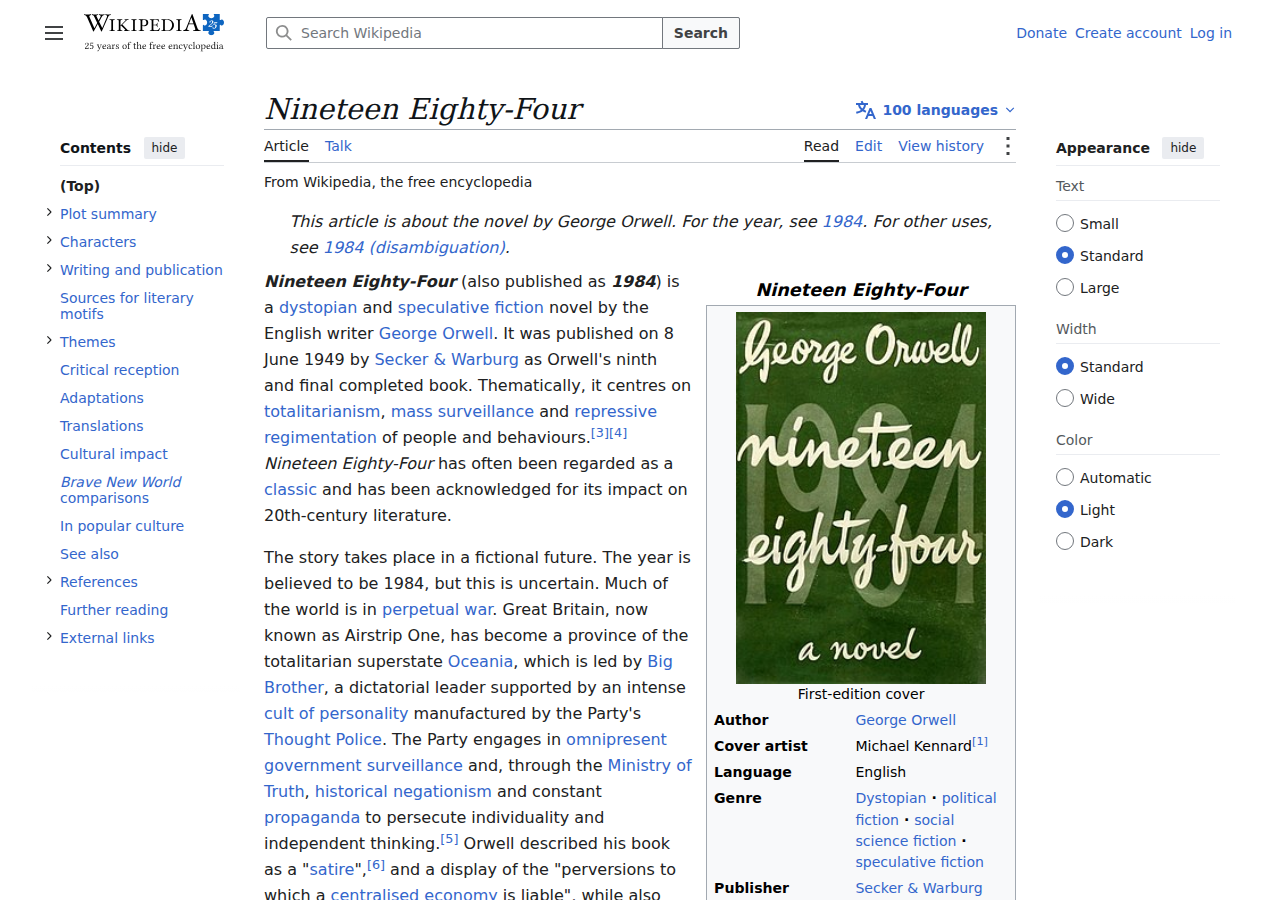
George Orwell published Nineteen Eighty-Four on June 8, 1949. He was dying of tuberculosis when he finished it. He had watched Stalinist propaganda operate at close range in the Spanish Civil War. He had watched the BBC — where he worked — manufacture consent for British policy. He had watched ideologically captured intellectuals in the West defend Soviet show trials, Soviet purges, and Soviet mass murder, because the ideology required them to.
He was not inventing a nightmare. He was describing a mechanism he had already seen.
This page maps that mechanism to the present. The examples are not speculative. They are documented.
The Core Mechanisms: What Orwell Described
1984's political theory is contained in the appendix ("The Principles of Newspeak") and in Emmanuel Goldstein's forbidden book ("The Theory and Practice of Oligarchical Collectivism," Book III, Chapter 1–3). The mechanisms are:
Doublethink: The ability to hold two contradictory beliefs simultaneously, know they contradict each other, believe both, and not feel the contradiction. The full definition, from Part 1, Chapter 3, is the most precisely constructed sentence in political literature:
"To know and not to know, to be conscious of complete truthfulness while telling carefully constructed lies, to hold simultaneously two opinions which cancelled out, knowing them to be contradictory and believing in both of them, to use logic against logic, to repudiate morality while laying claim to it — consciously to induce unconsciousness, and then to become unconscious of the act you had just performed. Even to understand the word 'doublethink' involved the use of doublethink."
(Part 1, Chapter 3)
The last two sentences are the philosophical core.
"Consciously to induce unconsciousness, and then to become unconscious of the act you had just performed."
This is what separates doublethink from hypocrisy. The hypocrite knows the truth and conceals it — the memory of the contradiction is intact, and could in principle be recovered. Doublethink goes further: it erases the memory of the choosing. You did not decide to believe the false thing. You simply believe it. The act of choosing is gone. You cannot look back and find the moment of decision because the mechanism destroyed that moment as it was operating.
"Even to understand the word 'doublethink' involved the use of doublethink."
This is the self-sealing recursive structure. To understand what doublethink is, you must be capable of holding two contradictory awarenesses simultaneously — knowing the contradiction while not feeling it. The concept defeats itself. The word cannot be understood by someone who isn't already performing the operation. It is a lock that requires the key to open itself.
This is why doublethink cannot be argued out of someone. It is not a position reached through reasoning that can therefore be reversed through better reasoning. It is a state in which the reasoning faculty has been partly suspended — and the suspension has been forgotten. The person performing it is not aware of performing it. To point out the contradiction is to perform the very thing they can no longer do: hold both awarenesses at once without resolving them.
Newspeak: The deliberate impoverishment of language to make certain thoughts impossible to express — and therefore impossible to think. Each year, the vocabulary of Newspeak shrinks. By the time the process is complete, "thoughtcrime" will be impossible, because there will be no words in which to express it. The goal is not to silence dissent — it is to make dissent literally unthinkable.
"Every concept that can ever be needed will be expressed by exactly one word, with its meaning rigidly defined and all its subsidiary meanings rubbed out and forgotten."
(Appendix: The Principles of Newspeak)
The Memory Hole: A slot in every Ministry office into which inconvenient documents, photographs, and records are dropped and incinerated. But the Memory Hole is not the mechanism — it is the symbol. The mechanism is the continuous rewriting of all records to match whatever the current version of history is. Yesterday's ally becomes today's enemy; today's truth is the truth that was always true.
Thoughtcrime: A thought that contradicts the Party's current position. It is the ultimate crime because it precedes all other crimes. You do not need to act on a thoughtcrime to be destroyed by it; the thought itself is the offense.
Crimestop (also: protective stupidity): The faculty, developed through conditioning, of stopping short before a dangerous thought is reached — of refusing to follow a chain of reasoning to a conclusion that would constitute thoughtcrime. Not conscious suppression, but instinctive aversion. The mind recoils from the dangerous idea before it can be formulated.
The Two Minutes Hate: A daily ritual of organized collective rage directed at the current enemy (Emmanuel Goldstein; also whichever external state is currently designated enemy). The function is not information — it is emotional conditioning: binding the group together through shared hostility, ensuring that hostility toward the designated enemy is reflexive rather than considered.
"We Have Always Been at War with Eurasia"
The passage the user notes come from is Part 1, Chapter 3. Winston Smith reflects on what he knows about the war:
He tried to remember in what year he had first heard mention of Big Brother. He thought it must have been in the sixties, but it was impossible to be certain. In the Party histories, of course, Big Brother figured as the leader and guardian of the Revolution since its very earliest days. His exploits had been gradually pushed backwards in time until already they extended into the fabulous world of the forties and the thirties...
And on the shifting of alliances:
At this moment, for example, in 1984 (if it was 1984), Oceania was at war with Eurasia and in alliance with Eastasia. In no public or private utterance was it ever admitted that the three powers had ever been grouped differently. Actually, as Winston well knew, it was only four years since Oceania had been at war with Eastasia and in alliance with Eurasia. But that was merely a piece of furtive knowledge which he happened to possess because his memory was not satisfactorily under control.
The mechanics:
- The alliance switches overnight. The enemy changes.
- All records are immediately updated to reflect that the new enemy has always been the enemy.
- Anyone who remembers the previous version knows that their memory contradicts the official record — and that their memory is, by definition, the wrong version. If everyone else accepts the lie, and every written record confirms the lie, then the person who remembers is the one who is wrong.
- "The lie passed into history and became truth." Winston reflects: If all records told the same tale — then the lie passed into history and became truth. 'Who controls the past,' ran the Party slogan, 'controls the future: who controls the present controls the past.'
Modern parallels:
-
"We have always defined 'woman' to include trans women." (Merriam-Webster updated its definition of "woman" in 2020 to include "a person whose gender identity is female." The previous definition did not include this. The new definition is now treated as the definition that was always correct.)
-
"Science has always recognized that sex is a spectrum." (Scientific taxonomy has classified animals into two sexes defined by gamete type for over two centuries. The "sex is a spectrum" framing is recent. It is now often presented as established science that was always true and only bigots dispute.)
-
Vaccine definition: In August 2021, the CDC updated its definition of "vaccine" — removing the word "immunity" ("a product that stimulates a person's immune system to produce immunity") and replacing it with language about producing "protection." The change was made during a period of debate about whether mRNA COVID vaccines prevented transmission. The new definition is now treated as if it were the original definition.
-
Recession: In July 2022, after two consecutive quarters of negative US GDP growth (the traditional technical definition of a recession), the White House and Treasury issued statements arguing that this did not constitute a recession — because the definition is more complex. Major media outlets and Wikipedia articles were updated to reflect the new, broader framing. Journalists who used the traditional definition were criticized for political bias.
-
"Gender-affirming care" has always been evidence-based." Multiple European countries (Sweden, Finland, Denmark, Norway, UK) conducted systematic reviews between 2020 and 2024 and concluded the evidence base for pediatric gender medicine was weak to absent. These same interventions were described as "well-established, evidence-based medical consensus" until the reviews appeared — after which the reviews were attacked as politically motivated.
The Memory Hole: Unpersoning and Erasing the Record
Winston's job at the Ministry of Truth is to update old newspaper articles, photographs, and records so that the past matches the current version of reality. People who have been "vaporized" (arrested, executed, and disappeared) are removed from all records — as if they never existed.
"Every record has been destroyed or falsified, every book has been rewritten, every picture has been repainted, every statue and street and building has been renamed, every date has been altered. And that process is continuing day by day and minute by minute. History has stopped. Nothing exists except an endless present in which the Party is always right."
The modern parallel:
-
J.K. Rowling and the Harry Potter 25th anniversary: In 2022–2023, multiple Harry Potter anniversary events and specials — including an HBO Max reunion special — were produced without including J.K. Rowling, the author of the books being celebrated. Cast members who had been her friends for over twenty years declined to appear alongside her or to mention her by name. The BBC documentary on 25 years of Harry Potter films did not feature her. The books exist; the author is being systematically removed from the public record of those books.
-
Wikipedia and contested figures: Wikipedia's editorial processes have been documented to systematically down-rank or remove positive coverage of individuals who hold politically disfavored positions, regardless of their historical significance, while elevating coverage of their critics.
-
Social media deletion and deplatforming: Accounts deleted. Posts vanished. Video removed. Search results suppressed. The effect is a real-time Memory Hole — the statement was made, it was shared, and then it ceased to exist in the infrastructure through which people find information.
-
Institutional name changes and statue removals: The rapid removal, renaming, and recontextualization of historical figures — without the historical record being replaced by more accurate history, but by its absence — maps to the Memory Hole more closely than to a scholarly revision of history.
The mechanism Orwell identified: It is not enough to suppress a statement once. The suppression must be continuous, because people will remember. The goal of the Memory Hole is not to hide an inconvenient fact in the present — it is to ensure that, eventually, no one who is left in the information environment has a memory of it. At that point, it never happened.
Newspeak: Changing the Words to Change What Can Be Thought
Orwell's appendix on Newspeak is the most precisely predictive part of the novel. The goal is not merely euphemism — it is the systematic replacement of precise language with imprecise language, so that the old thought becomes impossible to formulate, not just forbidden to express.
"The purpose of Newspeak was not only to provide a medium of expression for the world-view and mental habits proper to the devotees of Ingsoc, but to make all other modes of thought impossible."
Documented vocabulary changes — and what they do:
| Old term | New term | What the change does |
|---|---|---|
| Mother | "Birthing person," "gestational parent" | Removes the sex-specific term; makes "mother" unsayable in formal contexts |
| Father | "Non-birthing parent" | Same mechanism |
| Biological sex | "Sex assigned at birth" (SAAB) | Reframes an observed biological reality as an administrative assignment that could have been made differently — "assigned" implies arbitrary human choice, not observation |
| Breastfeeding | "Chestfeeding" | Removes female-specific anatomy from the term |
| Woman | "Person with a uterus," "menstruator" | Reduces women to body parts while making the category "woman" undefined |
| Vaccine (produces immunity) | Vaccine (produces protection) | Removes falsifiable criterion from definition |
| Recession (two quarters negative GDP) | Recession (multiple economic factors) | Removes falsifiable criterion from definition |
| Illegal alien | "Undocumented immigrant" | Removes legal status from description |
| Riot | "Unrest," "uprising" | Removes criminality from description |
| Grooming | (unsayable in many contexts) | The word for a specific pattern of child abuse has been so associated with "anti-LGBTQ bigotry" in media framing that it is now difficult to use in its original sense without triggering social recoil |
| Genocide (requires intent to destroy a group as such) | "Genocide" (applied to any large civilian death toll) | Expands the term to encompass ordinary warfare, undermining its specific legal and moral force |
The Newspeak mechanism in action: When Judge Ketanji Brown Jackson, nominated to the US Supreme Court, was asked by Senator Marsha Blackburn to define "woman" during her 2022 confirmation hearing, she answered: "I'm not a biologist."
This is not stupidity. It is a precise illustration of Newspeak's function: the word "woman" has been made sufficiently contested, politically charged, and undefined that a highly intelligent judge concluded it was safer to decline to define it than to offer a definition that any sufficiently motivated critic could attack. The word that was so obvious no one ever needed to define it has been rendered undefinable.
Thoughtcrime and Crimestop: The Persecution of Observable Fact
In 1984, thoughtcrime does not require an action. It does not require speech. It is detectable only through facial expression, through the wrong hesitation, through the instinctive flicker of doubt. The Thought Police are watching.
Winston reflects:
"Thoughtcrime does not entail death: thoughtcrime IS death."
In Orwell's world, the punishment for observable dissent from official reality is social death first, then actual death. In the present, the punishment is:
-
Employment termination: Dr. Allan Josephson, a 40-year child psychiatry expert at the University of Louisville, gave a lecture at a conservative think tank in 2017 stating that gender dysphoria in children should be treated with caution rather than immediate affirmation. He was demoted, his contract was not renewed, and he was effectively ended professionally. Federal appeals court allowed his case to proceed in 2021.
-
Professional license revocation: Multiple professional bodies — the British Columbia College of Physicians and Surgeons, various US state boards — have moved to discipline physicians who publicly question pediatric gender medicine, even when the physician's expressed view is consistent with the systematic reviews published by Sweden, Finland, and the UK's Cass Review.
-
Criminal prosecution: In the UK, people have been arrested and, in some cases, convicted for posting statements about biological sex on social media — statements that are factually accurate under any biological taxonomy. These are not threats. They are statements of fact that constitute, under UK law as currently applied, harassment.
-
Social destruction: The online mob — the Two Minutes Hate in real time. A statement is made; screenshots circulate; thousands of coordinated responses pile on; the target loses employment, social relationships, and public presence. The process takes hours. The trigger is often a factual statement about biology, immigration, or any other designated thoughtcrime topic.
Crimestop in practice: Many people who privately know what biological sex is — doctors, biologists, academics, journalists — will not say so publicly. Not because they have been told not to. Because they have been conditioned through repeated examples to know that saying it carries catastrophic professional and social risk. They stop themselves before the thought becomes a statement. Orwell called this protective stupidity — not the absence of intelligence, but the active deployment of intelligence against itself, in service of self-preservation.
"Man Is a Woman": The Demand That Exceeds Anything in 1984
The most striking observation in comparing Orwell to the present: what is demanded of us now goes further than what the Party demanded of Winston Smith.
Winston's struggle was with memory — specifically, memory of past events that the Party had retroactively revised. He remembered that Oceania had been allied with Eurasia four years ago. The record said they had always been enemies. He had to override his memory — a record of a past external event — with the Party's current version.
This is a significant demand. But it is a demand about the past. Memory is imperfect. Memory can be confused. The very mechanisms Elizabeth Loftus documented — that memory is reconstructive, not reproductive, that each retrieval rewrites the memory slightly — mean that even an honest person cannot be entirely certain their memory of a four-year-old alliance is accurate.
The demand that a biological male is a woman is a categorically different and harder demand.
It does not ask you to revise a memory of a past external event.
It asks you to override your present-tense sensory perception — what you can see in front of you, right now.
It asks you to override billions of years of evolved biological recognition — the instinctive, immediate identification of biological sex that all sexually reproducing species perform as a matter of survival. This is not a cultural acquisition. It is not a learned behavior. It is not a memory that can be confused. It is wired into the same neurological substrate as distinguishing food from not-food, or threat from not-threat. The identification is pre-rational and universal: every human culture that has ever existed has recognized the sex binary.
To make someone say "this person is a woman" when they can observe, by every biological marker available to them, that the person is male — this is not Orwell's memory hole. This is something harder.
Orwell's Party needed to control the past, because the past is abstract and exists only in records and memory. What is being demanded now is control of the present observable world — the subordination of immediate perception to ideological dictate.
If a movement can achieve that — if it can make people deny what is directly in front of them, what their own nature tells them is true, what every sensory system they have developed over a lifetime is telling them — then it has achieved a more complete form of reality control than Orwell imagined.
"Freedom is the freedom to say that two plus two make four. If that is granted, all else follows."
(Part 1, Chapter 7)
Orwell chose "two plus two make four" as his example of an irreducible truth — the kind of fact so basic that if you can be made to deny it, you can be made to deny anything.
The sex binary is older, more universal, more biologically embedded, and more directly observable than arithmetic. The demand to deny it is not Orwellian. It is beyond Orwellian.
Why this matters strategically: Precisely because the demand is so foundational, it functions as a test. The ideology does not need you to believe it. It needs you to say it. The public statement of something you know to be false — and the performance of believing it — is the mechanism of compliance. Once you have said it publicly, you have made yourself complicit. The larger the lie you have agreed to, the more invested you become in not admitting it was a lie. This is the mechanism Festinger documented in cognitive dissonance research: once the commitment is public and costly, the mind works to justify it rather than retract it.
Doublethink in Practice: The Contradictions Held Simultaneously
Doublethink is not hypocrisy — hypocrisy knows the contradiction and conceals it. Doublethink does not know the contradiction. Or rather: it knows, and immediately knows that it does not know. The contradictions are held in a state of suspension where neither is allowed to resolve.
Current documented examples:
"We support women's rights" + "Anyone who says there are meaningful differences between male and female bodies is a bigot." Women's rights, as a legal and social category, depend on the existence of "woman" as a distinct biological category that experiences sex-specific discrimination. A movement that simultaneously defends women's rights and denies the category of biological sex is holding both beliefs without allowing them to resolve.
"We support gay rights" + "We support Hamas / Palestine." Hamas executes gay men. The Palestinian Authority criminalizes homosexuality. The countries most vocal in calling for "Free Palestine" include Iran (executes gay men), which funds Hamas. The LGBT activist community that marched for Gaza in 2023-2024 was marching in support of, or at minimum in alliance with, organizations that would imprison or kill them for their sexual orientation. This contradiction was not examined at the marches.
"Diversity of viewpoints is our strength" + speech codes that prohibit certain viewpoints. Universities that produce statements about the importance of intellectual diversity simultaneously maintain policies under which professors can lose their positions for expressing views on biological sex, immigration, or racial differences in outcomes that contradict the official institutional position.
"Follow the science" + suppression of scientists who reach disfavored conclusions. The phrase "follow the science" is invoked to dismiss dissent. But when scientists conduct systematic reviews and find insufficient evidence for pediatric gender medicine (Sweden's National Board of Health, 2022; NICE systematic review, UK, 2020; Cass Review, UK, 2024), the response from advocates is not to update the scientific position — it is to attack the methodology, question the independence of the researchers, and assert that the "real" science says otherwise. "Follow the science" means follow our interpretation of science. Dissenting scientists are not wrong — they are dangerous.
"Genocide in Gaza" + silence on Sudan, China, Iran. The UNHRC has issued more resolutions against Israel than against North Korea, Syria, Iran, Sudan, and China combined. When faced with this fact, advocates of the "genocide" framing do not address the discrepancy — they dismiss it. The doublethink is holding "we care about genocide" and "we only investigate Israel" without feeling the contradiction.
The Two Minutes Hate: The Online Mob
Orwell's Two Minutes Hate is a daily ritual in which Party members watch a film of the enemy — Emmanuel Goldstein, Oceania's permanent internal threat — and scream, throw objects, and work themselves into collective rage. The function is not information. There is nothing to learn. The function is emotional and social: it trains automatic hostility toward the designated enemy and binds the group together through shared outrage.
"Within thirty seconds any pretence was always unnecessary. A hideous ecstasy of fear and vindictiveness, a desire to kill, to torture, to smash faces in with a sledge-hammer, seemed to flow through the whole group of people like an electric current, turning one even against one's will into a grimacing, screaming lunatic."
The architecture of social media — particularly Twitter/X — is designed to produce this effect at scale, continuously, and without a fixed daily ritual:
- Virality rewards outrage: Algorithmic amplification privileges content that generates strong emotional response. Outrage performs better than information.
- The pile-on: A single screenshot, stripped of context, circulated to a hostile audience. Within hours, thousands of coordinated responses. The target receives death threats, rape threats, messages at their employer.
- The designated enemy: The current targets — "transphobe," "racist," "fascist" — function identically to Emmanuel Goldstein. They are not individuals whose arguments are engaged with. They are objects of ritual condemnation.
- Mob participation as social performance: Participating in the pile-on signals loyalty to the group. Declining to participate — or, worse, defending the target — is evidence of insufficient orthodoxy. The Two Minutes Hate is a loyalty test as much as an emotional release.
- It ends careers: Unlike Orwell's Hate, the modern version has real-world professional consequences. The social destruction of the target is the point.
Party Slogans: Then and Now
Ingsoc's three slogans:
War is Peace. Freedom is Slavery. Ignorance is Strength.
These are not merely propaganda — they are logically inverted truths. The point of the inversion is that holding them requires overriding rational analysis. The mind that can hold these is the mind that has been trained not to examine them.
Current slogans with the same structural feature — the word means something closer to its opposite:
"Diversity is our strength" — in practice, applied to demographic diversity while reducing intellectual diversity (viewpoint diversity). An institution can be demographically diverse and ideologically uniform. The slogan defends one type of diversity while suppressing another.
"Silence is violence" — a literalization of the thoughtcrime concept: not acting against an ideology is redefined as an act of aggression. Absence of support = hostility. This eliminates the category of neutrality. Everyone must declare.
"Inclusion" — an institution that fires a professor for stating a biological fact about sex is described as practicing inclusion. The people excluded from inclusion are not named.
"Tolerance" — tolerance of all groups except those who question the ideology. Intolerance of the intolerant is described as tolerance.
"Safe space" — a space safe from disagreement. The original meaning of safety (physical threat) has been extended to cover intellectual challenge. "I feel unsafe" is the language of imminent physical danger applied to the experience of hearing an argument one finds uncomfortable.
"Anti-racism" — can mean judging people by their character rather than their race (the original civil rights framework), or can mean treating people differently based on race in pursuit of equity (the current DEI framework). These two definitions are directly contradictory. Both are called "anti-racism." The word contains its own doublethink.
Orwell's Conclusion: The Point Is Not Belief — It Is Submission
In Book III, O'Brien explains to Winston what the Party actually wants. It is not compliance. It is not even belief. It is something more complete:
"We are not content with negative obedience, nor even with the most abject submission. When finally you surrender to us, it must be of your own free will. We do not destroy the heretic because he resists us: so long as he resists us we never destroy him. We convert him, we capture his inner mind, we reshape him."
And later, the most chilling passage in the novel:
"If you want a picture of the future, imagine a boot stamping on a human face — forever."
But the operational insight — the one that distinguishes Orwell's analysis from mere pessimism — is this: the demand to say something you know to be false is not about the statement. It is about the demonstration of submission.
If you can be made to say a man is a woman when you can see he is not — or that you don't know what a woman is when you demonstrably do — then you have demonstrated that you will say whatever the ideology requires. That demonstration is the point. The belief doesn't matter. The public performance of the belief does.
Once that performance is given, and especially once it is given at professional or social cost, the person who gave it has invested too much to recant. They become, in Festinger's framework, an agent of the ideology — defending it to justify the cost they have already paid.
The counter: Asch's conformity research found that the presence of even one person willing to state the correct answer publicly — even one person willing to say "two plus two is four," "that person is male," "that is not a recession," "the allianceshifted four years ago" — dramatically reduced conformity in the group. The antidote to manufactured consensus is not a comprehensive rebuttal. It is someone willing to say the simple, obvious, observable truth, publicly, without flinching.
Orwell understood this. Winston knew 2+2=4. He wrote it in his diary. The act of writing it — privately, knowing it could destroy him — was the act of resistance.
The act of saying it, publicly, is the act of resistance now.
Primary Sources
George Orwell, Nineteen Eighty-Four (1949, Secker & Warburg)
- Part 1, Chapter 3: Winston's reflections on the war and shifting alliances
- Part 1, Chapter 7: "Freedom is the freedom to say two plus two make four"
- Part 3, Chapter 3: O'Brien's explanation of the Party's aims
- Appendix: "The Principles of Newspeak"
- Full text available via Project Gutenberg (out of copyright in many jurisdictions) and Internet Archive
George Orwell, "Politics and the English Language" (1946)
- On the deliberate obscuring of meaning through language — the essay that prefigures Newspeak
George Orwell, "Notes on Nationalism" (1945)
- On how ideological commitment produces the selective perception that enables doublethink
Elizabeth Loftus, The Myth of Repressed Memory (1994) — memory as reconstructive, not reproductive; connects to both recovered memory syndrome and the malleability of collective historical memory
Leon Festinger, When Prophecy Fails (1956) — cognitive dissonance and why committed believers intensify belief when the evidence fails them
Victor Klemperer, LTI: Lingua Tertii Imperii (1947) — Nazi language as the real-world precedent for Newspeak; language captured before the ideology fully conquered
Cass Review (2024), UK NHS — systematic review finding insufficient evidence base for pediatric gender medicine; example of doublethink dynamic (scientific review suppressed while "consensus" is claimed)
UK Home Office statistics on social media arrests — documented prosecutions for statements about biological sex