
The Anatomy of a Lie: Propaganda, Mass Hysteria, and the Tactics of Manufactured Belief
A reference guide to propaganda techniques, cult psychology, and documented cases of mass false belief — for use in evaluating speakers and identifying manipulation tactics.
This page is a reference tool. Its purpose is to name the techniques used to manufacture belief — in cults, in political movements, in medical establishments, in media — so they can be recognized when they appear. The tactics themselves are not new; what changes is the platform and the cause. Whether the manufactured belief was that Jews caused Germany's economic collapse, that lobotomies cured mental illness, that buried memories of satanic abuse could be recovered through hypnosis, or that biological sex is a social construct — the underlying mechanisms have documented patterns.
When evaluating a speaker, movement, or claim, this page provides the vocabulary to ask: which of these techniques is in use?
The Big Lie (Große Lüge)
The concept of the "big lie" comes from Adolf Hitler's Mein Kampf, Volume 1, Chapter 10 ("Causes of the Collapse"). The passage is widely misunderstood because Hitler was not advocating the technique for his own use — he was accusing Jews and Marxists of employing it to fabricate a narrative blaming Germany's WWI defeat on its military leaders:
"...in the big lie there is always a certain force of credibility; because the broad masses of a nation are always more easily corrupted in the deeper strata of their emotional nature than consciously or voluntarily; and thus in the primitive simplicity of their minds they more readily fall victims to the big lie than the small lie, since they themselves often tell small lies in little matters but would be ashamed to resort to large-scale falsehoods. It would never come into their heads to fabricate colossal untruths, and they would not believe that others could have the impudence to distort the truth so infamously."
Hitler was accurately describing a psychological truth while falsely attributing it to his enemies. The OSS psychological profile of Hitler (1943, Walter Langer) cited this passage and applied it to Hitler's own methods — this may be the origin of the inversion in popular memory.
The mechanism: The bigger the lie, the more credible it feels to ordinary people — because ordinary people don't fabricate enormous falsehoods and assume others don't either. Scale becomes plausibility.
Note on the Goebbels attribution: The famous quote "Repeat a lie often enough and it becomes the truth" is widely attributed to Joseph Goebbels but cannot be found in any of his authenticated writings or diaries. Researcher Randy Bytwerk (Calvin University), who maintains the German Propaganda Archive and has read Goebbels' corpus extensively, has searched for this quote and cannot locate it. Treat all "Goebbels said" versions of this claim as unverified. The principle itself is real — repetition creates familiarity, and familiarity is misread as truth (the "illusory truth effect," documented by Hasher, Goldstein & Toppino, 1977) — but it should not be cited as a Goebbels quote.
Crowd Psychology: Le Bon and Mackay
Charles Mackay — Extraordinary Popular Delusions and the Madness of Crowds (1841)
Scottish journalist Charles Mackay documented episodes of collective irrationality — from the Dutch Tulip Mania to the South Sea Bubble to witch trials — and drew a lasting observation about how group behavior departs from individual reasoning:
"Men, it has been well said, think in herds; it will be seen that they go mad in herds, while they only recover their senses slowly, and one by one."
(Note: verify exact wording against the original before citing; the phrasing appears in various slightly different forms across editions.)
Mackay's framework was pre-scientific — he was a journalist, not a psychologist — but his observation that collective delusion scales faster than collective recovery, and that individuals exit false belief one at a time even as they enter it in crowds, remains empirically supported by subsequent research on social contagion and information cascades.
Gustave Le Bon — The Crowd: A Study of the Popular Mind (1895)
French social psychologist Gustave Le Bon provided the first systematic attempt to describe the psychology of groups. He argued that crowds operate differently from the individuals who compose them:
"The opinions and beliefs of crowds are specially propagated by contagion, but never by reasoning."
And on how leaders shape group belief:
"The leaders we speak of are usually men of action rather than of words. They are not gifted with keen foresight... but they are endowed with very precise and very strong convictions... [Leaders] make use of affirmations, repetitions, and contagion."
Le Bon identified affirmation, repetition, and contagion as the three primary mechanisms of mass persuasion — not evidence, not argument. His work was directly influential on Hitler (who cited it in his own thinking), on Mussolini, and — more obliquely — on Bernays, who adapted Le Bon's crowd theory into his public relations methodology.
Source: Gustave Le Bon, The Crowd: A Study of the Popular Mind (1895; English translation, T. Fisher Unwin, 1896). Public domain. Charles Mackay, Extraordinary Popular Delusions and the Madness of Crowds (1841). Public domain.
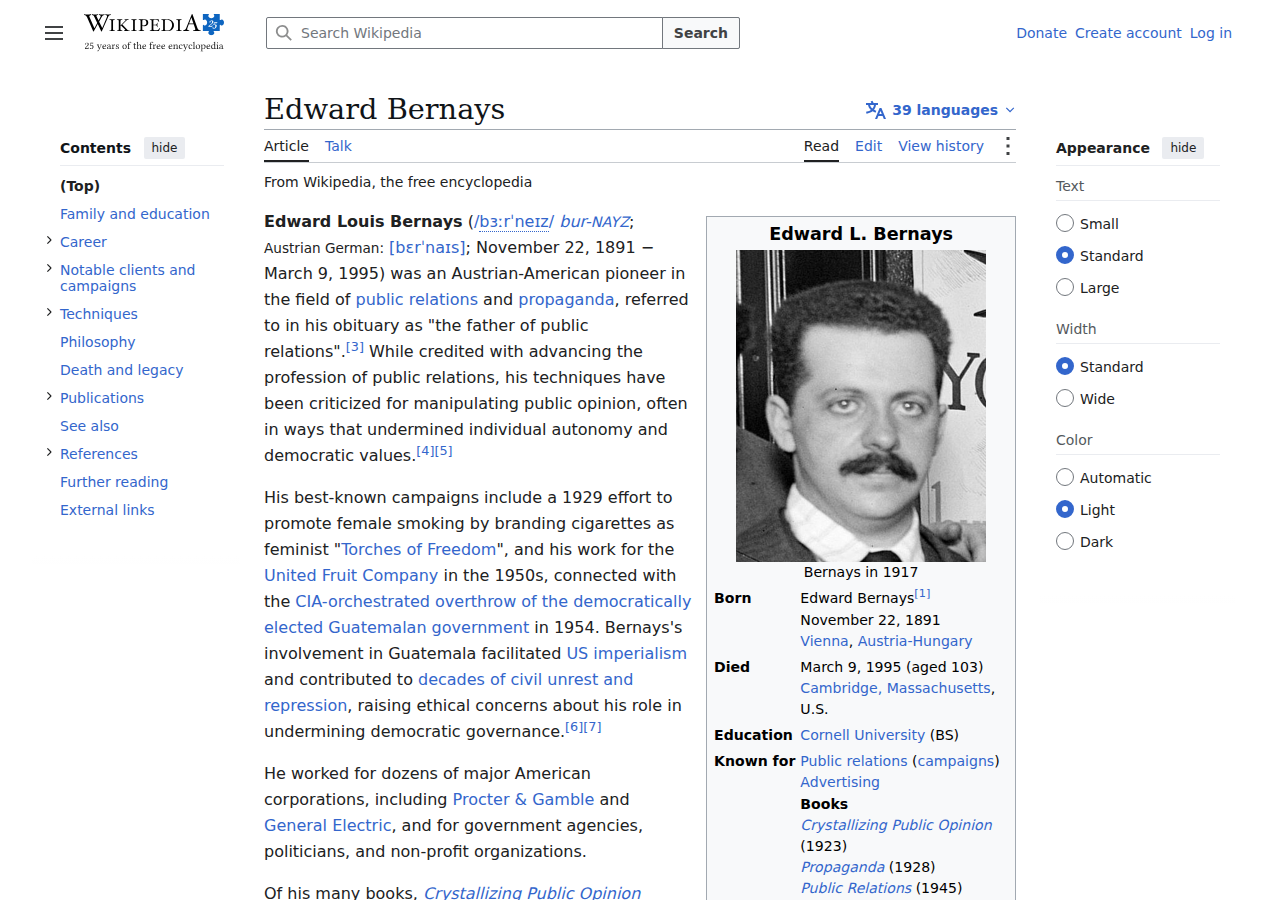
Engineering Consent: Edward Bernays (1928)
Edward Bernays — Sigmund Freud's nephew — founded the modern public relations industry and wrote Propaganda in 1928. He was explicit about what he was doing:
"The conscious and intelligent manipulation of the organized habits and opinions of the masses is an important element in democratic society. Those who manipulate this unseen mechanism of society constitute an invisible government which is the true ruling power of our country."
"We are governed, our minds are molded, our tastes formed, our ideas suggested, largely by men we have never heard of."
"If we understand the mechanism and motives of the group mind, is it not possible to control and regiment the masses according to our will without their knowing about it?"
— Edward Bernays, Propaganda (1928, Horace Liveright)
Bernays later coined the phrase "engineering of consent" (1947 article in The Annals of the American Academy of Political and Social Science). He is the reason cigarettes became associated with women's liberation (he arranged for suffragettes to smoke publicly and called cigarettes "torches of freedom"), and why Americans eat bacon and eggs for breakfast (a Beech-Nut Packing Company campaign). He understood that mass behavior is shaped by associating products and ideas with pre-existing emotions, group identities, and desires — not through rational argument.
The Social Psychology of False Belief
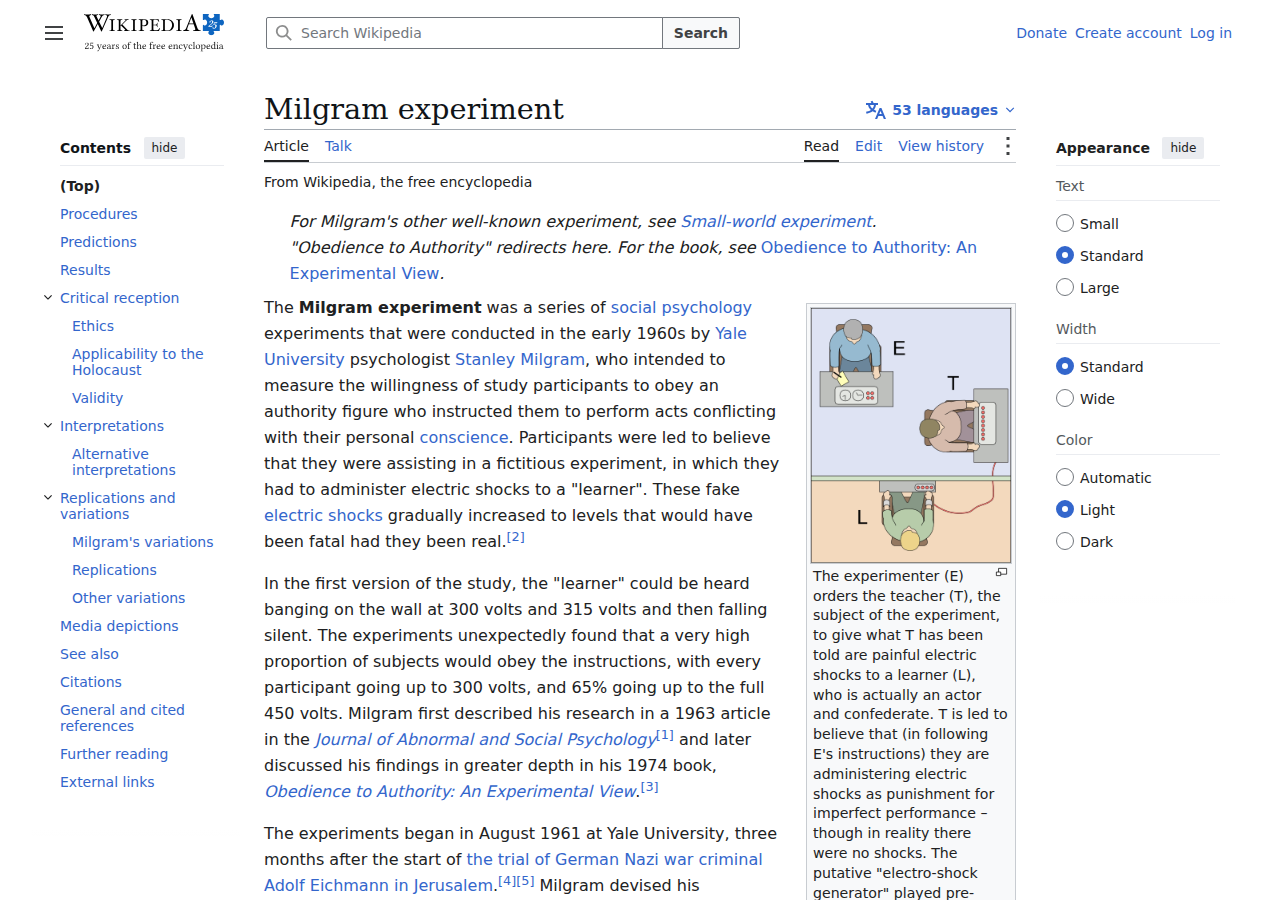
Milgram Obedience Experiments (1961–62)
Stanley Milgram, Yale University. Participants believed they were administering electric shocks to a "learner" for wrong answers, ranging from 15 to 450 volts labeled "XXX — Danger: Severe Shock." The learner was a confederate who screamed, demanded to stop, and eventually went silent. When participants hesitated, the experimenter said only: "Please continue," "The experiment requires that you continue," "You have no other choice, you must go on."
Result: 65% of participants (26 of 40 in the baseline condition) administered the maximum 450-volt shock. The experiment has been replicated cross-culturally, including by Jerry Burger (2009) at approximately 70% compliance.
What it shows: Ordinary people commit harmful acts under institutional authority without needing to be ideologically convinced — they need only a legitimate-seeming authority structure and incremental escalation. The Holocaust did not require millions of fanatics; it required millions of bureaucrats.
Asch Conformity Experiments (1951–56)
Solomon Asch, Swarthmore College. Participants were asked to match a line to one of three comparison lines — an objectively easy visual task. All others in the room were confederates who unanimously gave the wrong answer on 12 of 18 trials.
Result: 75% of participants conformed at least once and gave an answer they could see was wrong. Approximately 37% of all responses were conforming (wrong) answers. Only 25% never conformed.
What it shows: People will deny clear sensory evidence to match group consensus. The key finding is also the remedy: when Asch placed a single confederate who gave the correct answer, conformity dropped dramatically. One person willing to say the truth publicly gives others social permission to do the same.
Cognitive Dissonance (Leon Festinger, 1957)
Festinger's When Prophecy Fails (1956) studied a doomsday cult that predicted the world would end December 21, 1954. When the prophecy failed, most members increased their commitment and proselytizing rather than abandoning the belief. Festinger's explanation: when a belief is too central to abandon (it defines your social group, your identity, your life decisions), people reduce the dissonance by rationalizing the contradiction — the earth was saved by our faith — rather than discarding the belief.
Mechanism: Cognitive dissonance is the psychological discomfort of holding two contradictory beliefs. The three ways people resolve it: (1) change a belief, (2) add a new reconciling belief, or (3) dismiss the importance of one element. Option 1 — actually changing the core belief — is typically the hardest, especially when the belief is identity-embedded.
Implication: Presenting evidence against a strongly held belief may entrench it, because the dissonance-reducing response is not update the belief but explain away the evidence. The more public the commitment, the more painful the climb-down — and the more elaborate the rationalization.
The Illusory Truth Effect
Hasher, Goldstein & Toppino (1977) first documented that simply repeating a statement — regardless of its truth — increases the probability that it will be judged as true on a subsequent encounter. Familiarity is misread as truth. This effect persists even when subjects are told the statements may be false, and even when they have pre-existing correct knowledge that contradicts the statement.
Implication: Repetition alone is propaganda. It does not require emotional manipulation or authority — just frequency.
Thought Reform: Lifton's 8 Criteria and Hassan's BITE Model
Robert Lifton's 8 Criteria for Thought Reform
Source: Thought Reform and the Psychology of Totalism: A Study of "Brainwashing" in China (W.W. Norton, 1961), Chapter 22. Lifton studied Chinese Communist re-education programs applied to Western prisoners and Chinese intellectuals. He identified 8 defining features of any "totalistic" environment — cult, political movement, or institution:
-
Milieu Control — Total control of the individual's environment and communication. What information they access, what they discuss internally, who they spend time with. This is the foundational feature; all others depend on it.
-
Mystical Manipulation — The group claims a higher purpose that justifies deception. Leaders present themselves as having divine authority, special historical mission, or unique insight. Staged or coincidental events are presented as miraculous evidence of the group's special status.
-
Demand for Purity — The world is divided sharply into pure and impure, sacred and profane, us and them. The standard for purity is impossible to meet, creating perpetual guilt and dependence on the group for forgiveness.
-
Confession — Sins (as defined by the group) must be confessed, often publicly. This serves to extract information about the individual, bind them to the group through shared secrets and complicity, and establish the group's authority over private life.
-
Sacred Science — The group's doctrine is the ultimate truth, beyond question or empirical challenge. Questioning it is not merely wrong — it is morally transgressive, evidence of weakness, sin, or enemy allegiance.
-
Loading the Language — A specialized jargon develops that shortens and compresses thought. Lifton called these thought-terminating clichés — phrases that feel like conclusions but actually stop analysis. Insiders can no longer think in other terms; outsiders cannot understand internal discussions. (Examples: "reactionary," "class traitor," "that's just your privilege talking," "doing the work.")
-
Doctrine over Person — Individual experience and memory are subordinated to doctrine. If your personal experience contradicts the teaching, your experience is wrong. History is revised to conform to present doctrine. Members who experienced something that doesn't fit are told they misremember or misunderstood.
-
Dispensing of Existence — The group claims the right to decide who has a legitimate right to exist — spiritually, socially, or physically. Non-members are subhuman, lost, damned, or the enemy. This creates the psychological precondition for dehumanization and violence.
Steven Hassan's BITE Model
Source: Combating Cult Mind Control (1988, updated 2018); The Cult of Trump (2019). Hassan is a former Unification Church member and cult exit counselor. The BITE model identifies four domains of control:
Behavior Control: Regulate diet, sleep, finances, housing, sexual behavior. Major life decisions require group approval. Financial exploitation. Restrict free time; demand group activities.
Information Control: Deceptive recruitment (hide group identity; "love bombing" before expectations are revealed). Restrict access to outside information — no critical reading, discourage contact with former members or critics. Label outside sources as evil, spiritually contaminating, or "persecution." Encourage members to report on each other.
Thought Control: Thought-stopping techniques (chanting, meditation, repetitive prayer) used to suppress doubts when they arise. Black-and-white, all-or-nothing thinking. Loaded language makes certain conclusions unreachable. Only group-approved questions are permitted — the answer is always predetermined.
Emotional Control: Manipulate fear (spiritual consequences for leaving, social death, physical danger). Guilt and shame cycles maintain compliance. Love bombing — overwhelming affection for new recruits that is withdrawn as leverage once commitment deepens. Phobia indoctrination: catastrophize departure. Suppress negative emotions; perform happiness and certainty.
Conspiracy Thinking: The Unfalsifiable Claim
Karl Popper identified the central epistemic flaw of conspiracy theories in The Open Society and Its Enemies (1945) and Conjectures and Refutations (1963): the conspiracy theory of society treats all social events as the result of deliberate scheming by identifiable groups. The structural problem is unfalsifiability — any counter-evidence becomes proof of the conspiracy. The absence of evidence is reframed as evidence of how deep the cover-up goes.
Hallmarks of unfalsifiable conspiracy thinking:
- Irrefutable by design: A theory that cannot be proven wrong is not a theory — it is an assertion. Scientific theories make predictions that could, in principle, be falsified.
- The counter-evidence pivot: "The documents proving my claim were destroyed/suppressed/classified." "The experts who disagree have been paid off." Any fact that should disprove becomes proof of the conspiracy's scope.
- Pattern-matching without causation: Noticing that events are connected without demonstrating a causal mechanism. Coincidences are treated as impossible; therefore they must be engineered.
- The moving target: When specific predictions fail, the theory absorbs the failure and continues. QAnon's repeated unfulfilled "proofs" did not collapse the movement — each failure was reframed.
- Special pleading: Normal rules of evidence don't apply because the conspiracy controls the evidence-gathering apparatus.
Why conspiracy theories are emotionally compelling:
- They provide simple explanations for complex, painful events (random tragedy is psychologically harder to accept than deliberate evil)
- They confer status: the believer knows what the sheeple don't
- They provide a community of fellow believers
- They give agency: the enemy can be named and fought
The Gish Gallop: Named by skeptic Eugenie Scott for creationist debater Duane Gish — flooding an opponent with a large number of low-quality arguments faster than they can be individually refuted. In debate or media format, this appears as a win even when every claim is false, because the number of responses required exceeds available time. The audience misreads rebuttal volume as substantive dispute.
Taxonomy of Manipulation Tactics
These are the named techniques most frequently employed in propaganda, demagoguery, conspiracy media, and cult recruitment. Recognizing the technique does not automatically refute the claim — some claims may be true even when the argument for them is manipulative — but it identifies where to apply additional scrutiny.
| Tactic | Definition | Red Flag |
|---|---|---|
| Ad Hominem | Attack the person, not the argument | Responding to evidence by questioning the speaker's motives, credentials, or character rather than the claim |
| Appeal to Authority | Use of a prestigious figure's opinion outside their expertise | "Nobel laureate X believes Y" — where Y is outside X's field |
| Bandwagon / Ad Populum | "Everyone believes this" as argument for correctness | Social pressure substituted for evidence |
| Black-and-White / False Dichotomy | Present only two options when more exist | "You're either with us or against us" |
| Cherry-Picking | Selecting only supporting evidence while suppressing contrary evidence | Citing three studies while ignoring thirty contradictory ones |
| Dog Whistle | Language that appears neutral to outsiders but carries coded meaning to a target audience | |
| Epistemic Cowardice | Deliberate vagueness to avoid stating a clear position and its consequences | "I'm just asking questions" |
| False Equivalence | Treating two unequal things as comparable | Presenting fringe view and scientific consensus as "two sides" |
| Fear Appeal | Using fear disproportionate to actual risk | "If we don't act now, everything will be destroyed" |
| Firehose of Falsehood | High-volume, contradictory, partially true claims faster than they can be debunked (RAND analysis of Russian state media) | Volume itself becomes a defense |
| Framing / Controlling the Frame | Determining which aspects of an issue are considered relevant before debate begins | The answer is baked into how the question is posed |
| Gish Gallop | Overwhelming an opponent with numerous low-quality arguments (Eugenie Scott, after creationist Duane Gish) | Winning by volume, not quality |
| Illusory Truth Effect | Repetition alone increases perceived truth regardless of evidence | Media saturation as persuasion |
| Loaded Language | Words chosen for emotional connotation: "enhanced interrogation," "pro-life," "illegal alien" | George Orwell, "Politics and the English Language" (1946): "designed to make lies sound truthful and murder respectable" |
| Milieu Control | Controlling the information environment to prevent encountering counter-evidence | |
| Motte and Bailey | Conflating a defensible modest claim (motte) with an indefensible sweeping one (bailey), retreating to the motte when challenged | Named by philosopher Nicholas Shackel (2005) |
| Moving the Goalposts | Changing the criteria for evidence after the original standard is met | |
| Overton Window | Shifting what counts as acceptable discourse by introducing previously extreme positions | |
| Red Herring | Irrelevant information introduced to distract from the main argument | |
| Sacred Science | Declaring a belief system beyond empirical challenge | Questioning = moral failure, not intellectual inquiry |
| Scapegoating | Attributing complex societal problems to a specific group | René Girard, Violence and the Sacred (1972): scapegoating channels collective anxiety into directed hostility |
| Semmelweis Reflex | Reflexive rejection of new evidence because it contradicts established norms or implicates the establishment | Named for Ignaz Semmelweis, whose handwashing findings were rejected because they implied doctors were killing patients |
| Slippery Slope | Claiming one event leads inevitably to extreme consequences without demonstrating the causal chain | |
| Straw Man | Misrepresenting an opponent's position to make it easier to refute | |
| Thought-Terminating Cliché | Phrases that feel like conclusions but stop analysis (Lifton) | "That's just your privilege," "Love it or leave it," "God's will" |
| Whataboutism (Tu Quoque) | Responding to criticism by pointing at a different problem | Documented Soviet/Russian rhetorical practice; evades accountability without addressing the charge |
Case Studies in Mass False Belief
These cases demonstrate that mass false beliefs are not unique to the uneducated, the credulous, or historical primitives. They have occurred in modern democratic societies, endorsed by mainstream institutions, peer-reviewed journals, Nobel committees, and Supreme Courts. Each case followed a recognizable pattern.
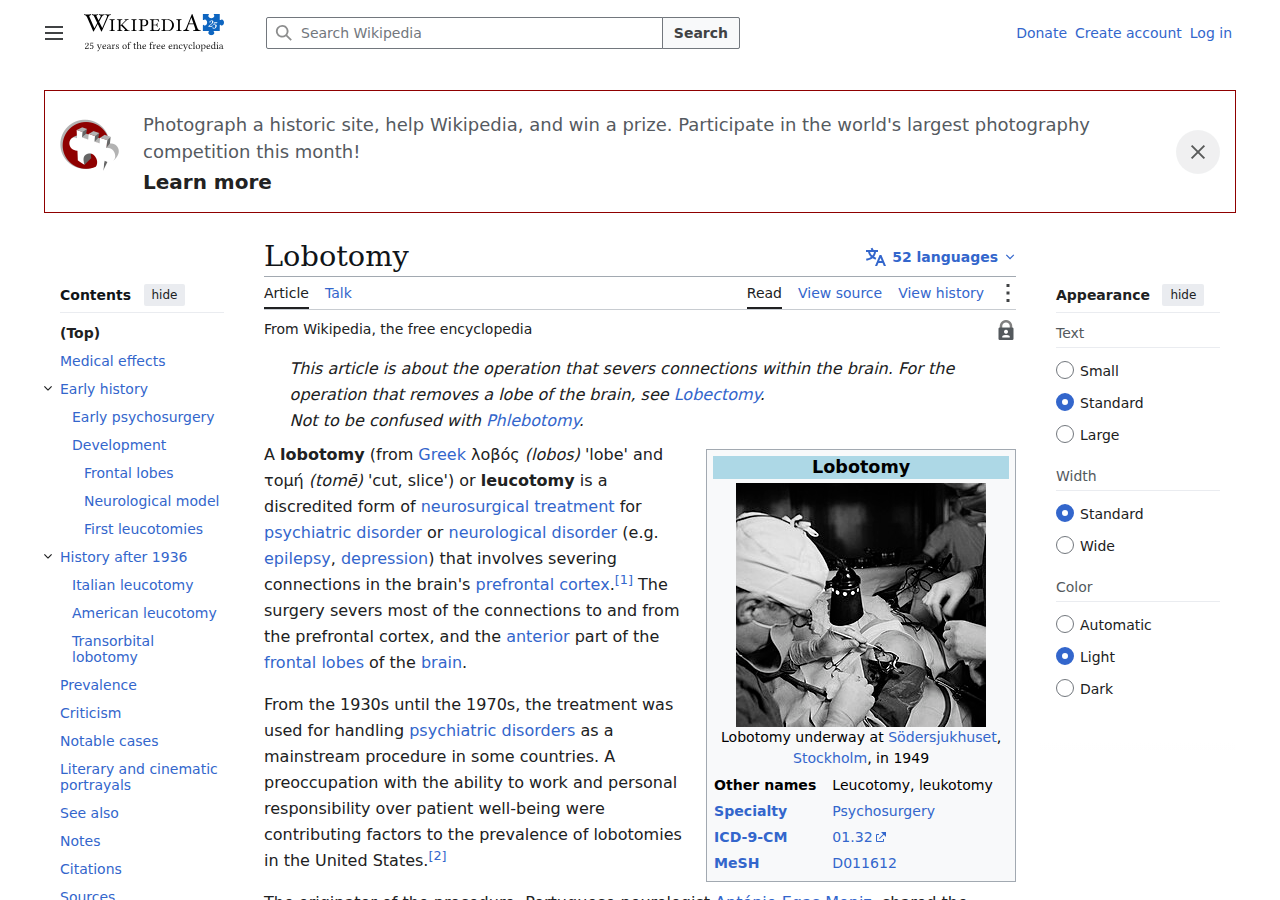
1. Lobotomy: Medical Consensus That Was Wrong
The false belief: Severing the frontal lobes of the brain is an effective treatment for mental illness.
Timeline:
- 1935: Portuguese neurologist António Egas Moniz performs the first prefrontal leucotomy in Lisbon.
- 1936: Walter Freeman and James Watts introduce the procedure to the United States.
- 1945: Freeman develops the transorbital lobotomy — an ice-pick-like tool inserted through the eye socket, no drilling required, 10-minute procedure, no surgeon needed. Freeman would perform these in non-surgical settings.
- 1949: Egas Moniz receives the Nobel Prize in Physiology or Medicine "for his discovery of the therapeutic value of leucotomy in certain psychoses."
- 1950s: Freeman travels the United States in a camper van he calls the "lobotomobile," performing mass lobotomies at state hospitals — sometimes 25 operations in a single day.
- Late 1950s: The antipsychotic drug chlorpromazine (Thorazine, 1952) provides a pharmaceutical alternative. Lobotomy falls out of mainstream use.
- 1967: Freeman performs his last lobotomy. The patient dies. His hospital privileges are permanently revoked.
Scale: Freeman personally performed approximately 2,500 lobotomies. US total: an estimated 40,000–50,000 procedures. Global total: estimated 70,000–80,000.
Notable patient: Rosemary Kennedy, sister of JFK, was lobotomized by Freeman in 1941 at age 23 at the request of her father, Joseph Kennedy. She regressed to the mental capacity of a 2-year-old and was institutionalized for the remaining 63 years of her life.
What went wrong: There were no randomized controlled trials. Patient reports of improvement were collected by the same physicians who performed the procedures, creating obvious selection bias. The Nobel Prize was awarded before systematic follow-up data existed. The procedure was validated by institutional authority, not evidence.
Lesson: A Nobel Prize, mainstream medical consensus, and enthusiastic institutional adoption are not evidence of effectiveness. They are evidence that the evidence base was not rigorously examined.
Source: Jack El-Hai, The Lobotomist (Wiley, 2005).
2. "Smoking Is Healthy": The Manufactured Doubt Campaign
The false belief: Smoking is safe, or the science on smoking's harms is contested.
The strategy — "Doubt is our product":
In 1969, a Brown & Williamson Tobacco Corporation internal memo articulated the industry's strategy:
"Doubt is our product since it is the best means of competing with the 'body of fact' that exists in the mind of the general public. It is also the means of establishing a controversy."
The goal was not to prove cigarettes were safe. It was to manufacture uncertainty — to convert scientific consensus into a "controversy" in the public mind.
How it worked:
- 1953 "Frank Statement to Cigarette Smokers": Full-page ads in newspapers across the US, signed by tobacco company executives, promising independent research and claiming public health concern — while internal documents show they already knew smoking caused cancer.
- Tobacco Industry Research Committee: Created to simulate scientific inquiry. Funded contrarian scientists to publish doubt-generating papers, creating the appearance of a debated question in peer-reviewed literature.
- Expert laundering: Paid scientists and doctors to publicly endorse cigarettes. Ads featuring "More Doctors Smoke Camels" ran into the 1950s.
- Internal documents from the 1950s explicitly show company executives knew of cancer links while publicly denying them.
Outcome: The 1998 Master Settlement Agreement required US tobacco companies to pay 46 states $206 billion. The FDA gained authority to regulate tobacco in 2009. The internal documents (now available at the UCSF Truth Tobacco Industry Documents database) became the documentary record of the strategy.
Legacy: The "doubt is our product" strategy was directly adopted by subsequent industries — climate change denial, anti-vaccine lobbying — as a documented template. Naomi Oreskes and Erik Conway trace this lineage in Merchants of Doubt (Bloomsbury, 2010).
What went wrong: The public assumed that if genuine experts disagreed, the science must be uncertain. The tobacco industry manufactured the appearance of expert disagreement artificially. The asymmetry between creating doubt (cheap) and establishing consensus (expensive) was exploited systematically.
3. Eugenics: "Scientific" Consensus That Justified Mass Atrocity
The false belief: Human beings can and should be selectively bred to eliminate "defective" traits; certain races, classes, and conditions are genetically inferior and should be prevented from reproducing.
Institutional endorsement: In the early 20th century, eugenics was not fringe — it was mainstream science:
- Harvard, Yale, Stanford, and Princeton offered eugenics courses
- The American Eugenics Society (founded 1926) included leading biologists and physicians
- The Eugenics Record Office at Cold Spring Harbor Laboratory was funded by the Carnegie Institution and the Harriman railroad family
- The Rockefeller Foundation funded eugenics research in Germany as late as 1939
- The first two presidents of Stanford (David Starr Jordan) were prominent eugenicists
Buck v. Bell (1927): Carrie Buck v. Dr. J.H. Bell, 274 U.S. 200. The US Supreme Court upheld Virginia's compulsory sterilization law 8-1. Justice Oliver Wendell Holmes Jr. wrote the majority opinion:
"We have seen more than once that the public welfare may call upon the best citizens for their lives. It would be strange if it could not call upon those who already sap the strength of the State for these lesser sacrifices... Three generations of imbeciles are enough."
The truth about Carrie Buck: Subsequent historical research (Paul Lombardo) showed that Carrie Buck was not intellectually disabled. She had been raped by a nephew of her foster family and was committed to prevent embarrassment to that family. Her daughter Vivian, cited as the "third generation of imbeciles," performed adequately in school before dying at age 8.
Scale: Approximately 60,000–65,000 people were forcibly sterilized under US state eugenics laws between 1907 and the 1970s. California performed roughly one-third of all US cases. Nazi Germany's eugenics program was explicitly modeled on American eugenics law; German officials cited Buck v. Bell approvingly.
How it ended: The documented atrocities of Nazi eugenics programs forced a reckoning. UNESCO's "Statement on Race" (1950) formally repudiated the scientific basis of racial hierarchy. The American Eugenics Society quietly renamed itself the "Society for the Study of Social Biology" in 1972.
Lesson: A position can be endorsed by the Supreme Court, by Ivy League universities, by Carnegie and Rockefeller foundations, by Nobel-adjacent scientists — and still be false, and still be used to justify atrocities. Institutional authority is not truth.
4. Recovered Memory Syndrome and the Satanic Panic
The false belief: Adults with no conscious memory of childhood abuse can recover those "buried" memories through therapy; therapists can reliably distinguish genuine recovered memories from false ones; widespread Satanic ritual abuse of children was occurring in American daycare centers.
McMartin Preschool Case (1984–1990): Manhattan Beach, California. The longest and most expensive criminal trial in US history at the time. Cost: approximately $15 million. Duration: approximately 7 years from arrest to final acquittals.
What happened: Children were interviewed by therapists at Children's Institute International using highly suggestive, leading techniques grounded in the theory that children needed "permission" to disclose abuse and would minimize it unless pressed. Therapists asked repeatedly until children produced accounts of underground tunnels, flying, animal sacrifice, and teachers in robes. Parents were told their children had been abused.
Outcome: No convictions. All charges were either dropped or resulted in acquittals. In 1990, archaeological excavation of the school site found no tunnels or buried evidence.
Paul Ingram Case (1988, Yelm, Washington): Ingram was a police officer and county Republican Party chairman. His daughters accused him of Satanic ritual abuse. After intensive questioning by detectives and a Christian pastor, Ingram began producing "confessions" to acts he had no memory of committing. Social psychologist Richard Ofshe (UC Berkeley), brought in as a consultant, demonstrated that Ingram could be induced to confess to events Ofshe had fabricated on the spot — proving the confessions were created through suggestion, not retrieved from memory. Ingram pleaded guilty under pressure and served 14 years. Source: Lawrence Wright, Remembering Satan (Knopf, 1994).
Elizabeth Loftus — False Memory Research: Loftus and Pickrell (1995) demonstrated that approximately 25% of subjects could be induced to "remember" a false childhood event (being lost in a shopping mall) that their family confirmed never happened. Her book The Myth of Repressed Memory (1994, with Katherine Ketcham) provided the empirical framework showing that memory is reconstructive, not reproductive — each retrieval rewrites the memory.
Multiple Personality Disorder epidemic: Before 1980, fewer than 200 cases had been documented globally. After MPD was added to DSM-III and the book/film Sybil (1973/1976) popularized the concept, the US diagnosed population reached an estimated 40,000+ by the early 1990s. The syndrome clustered around specific therapists and geographic areas — a pattern more consistent with iatrogenic (therapist-caused) creation than with genuine pathology. Psychiatrist Herbert Spiegel (who also treated Sybil) later said the case was substantially fabricated, partly by therapist Cornelia Wilbur.
How it ended: Ofshe's testimony, Loftus's research, and eventually prosecutorial reversals began unwinding the convictions. Many Satanic Panic convictions were overturned on appeal. The psychiatric community substantially walked back the recovered memory framework in subsequent DSM revisions.
Lesson: The "victims are always telling the truth" presumption, combined with suggestive therapeutic techniques, produced mass false accusations. The harm fell on innocent people convicted of crimes that never occurred. The people most harmed by applying the wrong framework were the very people the framework claimed to protect.

5. Nazi Germany: The Mechanics of Mass Scapegoating
The false belief: Jews caused Germany's economic problems, engineered its WWI defeat, and constituted an existential threat requiring elimination.
The Dolchstoßlegende ("Stab in the Back" Myth): Popularized after WWI, particularly through a 1919 interview with German generals Ludendorff and Hindenburg, who implied Germany had been stabbed in the back by internal enemies — Jews, Marxists, defeatists — rather than defeated militarily. The myth was demonstrably false (Germany was militarily exhausted and close to collapse in 1918), but it provided a psychologically satisfying explanation that required no military or strategic reckoning. The army was invincible; it was betrayed. This foundational grievance narrative underpinned Weimar-era antisemitism and became the rhetorical foundation of Nazi politics.
The propaganda structure:
- Complex economic problems (hyperinflation, unemployment, war reparations) were attributed to Jewish financial manipulation — converting diffuse, legitimate economic anxiety into directed hatred at an identifiable group
- The enemy was presented as both powerful (controlling banks, media, governments) and subhuman (racial caricatures) simultaneously — the tension between these claims was never examined
- Victor Klemperer, a Jewish professor who survived the Nazi period in hiding, documented in LTI: Lingua Tertii Imperii (1947) how the language of the Third Reich functioned — "ten words" of Nazi vocabulary, he wrote, could replace a paragraph of rational argument with a conditioned reflex
Joseph Goebbels' documented approach (from diary entries and speeches analyzed by historians; see German Propaganda Archive, Calvin University):
- Simplification: complex issues reduced to clear friend/enemy dichotomies
- Enemy identification: effective propaganda requires a single recognizable enemy
- Emotional primacy: propaganda must appeal to feeling, not intellect
- Unanimity illusion: create the impression everyone agrees; isolate dissenters psychologically
McCarthyism — The American Parallel: Senator Joseph McCarthy's anti-Communist campaign (1950–54) used the same basic structure: a threat from within (Communists in government), unfalsifiable accusations (the accused could not prove a negative), and social terror. On June 9, 1954, during the Army-McCarthy hearings, attorney Joseph Welch delivered the line that ended McCarthy's public career:
"Until this moment, Senator, I think I never really gauged your cruelty or your recklessness. [...] Have you no sense of decency, sir? At long last, have you left no sense of decency?"
The gallery broke into applause. The Senate voted to censure McCarthy 67-22 on December 2, 1954. He died in office in 1957. Historian Ellen Schrecker estimates total affected — job losses, destroyed careers — in the tens of thousands.
The Origins of "Die Juden sind unser Unglück" ("The Jews Are Our Misfortune"):
The phrase that Der Stürmer printed on every front page from 1927 onward did not originate with the Nazis — it originated in an 1879 article by historian Heinrich von Treitschke in Preussische Jahrbücher (November 15, 1879). Treitschke was a respected mainstream historian, not a fringe figure. His use of the phrase gave the later Nazi propaganda a veneer of historical and intellectual respectability. The words came from the establishment; the Nazis amplified them.
Julius Streicher and the Blood Libel:
Julius Streicher, publisher of the Nazi newspaper Der Stürmer, devoted a special issue in May 1934 to the blood libel — the medieval antisemitic claim that Jews abducted and ritually murdered Christian children to use their blood in religious ceremonies. The headline declared: "Jewish Murder Plan against Gentile Humanity Revealed." The text accused Jews of "enticing Gentile children and Gentile adults, butchering them, and draining their blood."
The blood libel is not a Nazi invention. It dates to medieval Europe, with the first documented case in Norwich, England, in 1144. It was revived and industrialized by Nazi propaganda as a deliberate technique to dehumanize Jews beyond the level of economic or political antagonism — to make them physically dangerous, predatory, a threat to children. Streicher was tried at Nuremberg specifically for his role in the Der Stürmer incitement campaigns and was executed in 1946.
Source: Deutsches Historisches Museum; German History in Documents and Images (GHDI); US Holocaust Memorial Museum (USHMM) Holocaust Encyclopedia; Calvin University German Propaganda Archive.
Ben Shapiro Episode 2459: Debunking Conspiracy Tactics
In Episode 2459 of The Ben Shapiro Show (The Daily Wire), Shapiro addresses conspiracy theories associated with Candace Owens — his former colleague who departed The Daily Wire in March 2024 — and identifies the specific rhetorical tactics used in conspiracy media.
Owens had been promoting content about Jewish influence that her Daily Wire colleagues publicly criticized as antisemitic, along with other conspiracy-adjacent material. Shapiro's episode is notable because he provides concrete examples of how manipulation tactics appear in practice from a practitioner's perspective within conservative media.
Screenshot below captures the episode's publicly available description and/or discussion of the tactics Shapiro identifies. For the full analysis, see the episode directly through The Daily Wire.
Applying the Framework: Red Flags When Evaluating a Speaker
When evaluating any speaker, media source, or movement, these patterns — individually or in combination — indicate manipulation rather than argument:
Epistemically red:
- Claims that cannot be falsified ("the evidence was destroyed/suppressed")
- Counter-evidence is immediately reframed as further proof of the conspiracy
- Credentials of critics are attacked rather than their arguments
- The speaker "just asks questions" without taking positions they can be held to
- Statistics cited without methodology ("studies show" with no citation)
Rhetorically red:
- Floods of claims faster than they can be individually checked (Gish Gallop)
- Emotionally loaded language substituting for description ("invasion," "grooming," "genocide")
- Framing that makes only one conclusion possible before evidence is examined
- Specific predictions about future revelations that repeatedly don't materialize
Socially red (cult markers):
- Restricts information environment: discourages outside reading, labels outside sources as controlled/enemy
- Demands purity: you're either fully with us or you're against us/a traitor/compromised
- Sacred science: the core belief is beyond question; questioning it is a character failing
- Thought-stopping clichés instead of engagement with counter-arguments
- Isolation: relationship with people outside the movement weakens; relationship with believers strengthens
The practitioner's tell: The most sophisticated manipulators combine accurate premises with false conclusions. They cite real statistics, real studies, real events — but select, frame, and connect them in ways designed to produce a predetermined conclusion. The vaccine-autism fraud (Andrew Wakefield, 1998 Lancet) used real children, real measurements, and a real journal — the fraud was in the methodology and the undisclosed conflicts of interest. The fact that some elements are true does not validate the conclusion.
The counter: Asch's conformity research found that one person publicly stating the correct answer dramatically reduced group conformity. The antidote to manufactured consensus is not complex argument — it is social permission to dissent. Someone willing to say clearly "that's not true" is more powerful than an elaborate rebuttal.
Primary Sources and Further Reading
Foundational texts:
- George Orwell, "Politics and the English Language" (1946) — on the deliberate obscuring of meaning through language
- Edward Bernays, Propaganda (1928, Horace Liveright) — full text, Internet Archive
- Robert Jay Lifton, Thought Reform and the Psychology of Totalism (1961, W.W. Norton)
- Hannah Arendt, The Origins of Totalitarianism (1951) — on the mechanisms of mass political movements
- Victor Klemperer, LTI: Lingua Tertii Imperii (1947) — Nazi language as propaganda mechanism
Social psychology:
- Stanley Milgram, Obedience to Authority (1974, Harper & Row)
- Solomon Asch, "Opinions and Social Pressure," Scientific American (1955)
- Leon Festinger, When Prophecy Fails (1956, University of Minnesota Press)
Case studies:
- Naomi Oreskes and Erik Conway, Merchants of Doubt (2010, Bloomsbury) — tobacco + climate denial
- Jack El-Hai, The Lobotomist (2005, Wiley) — Walter Freeman biography
- Lawrence Wright, Remembering Satan (1994, Knopf) — Paul Ingram / recovered memory
- Elizabeth Loftus and Katherine Ketcham, The Myth of Repressed Memory (1994, St. Martin's Press)
- Paul Lombardo, Three Generations, No Imbeciles (2008, Johns Hopkins) — Buck v. Bell and eugenics
Academic databases:
- German Propaganda Archive, Calvin University — verified Goebbels and Nazi texts
- UCSF Truth Tobacco Industry Documents — internal tobacco industry documents
- National Registry of Exonerations — includes Satanic Panic reversals