
Global Terrorism: Definition, Statistics, Ideology, and the Religion Question
What terrorism is, who commits it, and what the global data actually shows about ideology and religion — with a documented table of major attacks.
This page documents the global record of terrorism: what terrorism is defined as, who commits it, and what the data shows about the relationship between ideology, religion, and mass violence. The data does not support the claim that "terrorism has no religion" — but it also requires precision about which data set, which definition, and which geography one is examining.
What Is Terrorism? Competing Definitions
There is no single universally agreed definition of terrorism. The major operational definitions share common elements:
UN Security Council Resolution 1566 (2004):
"Criminal acts, including against civilians, committed with the intent to cause death or serious bodily injury, or taking of hostages, with the purpose to provoke a state of terror in the general public or in a group of persons or particular persons, intimidate a population or compel a government or an international organization to do or to abstain from doing any act."
FBI (United States):
"Violent, criminal acts committed by individuals and/or groups to further ideological goals stemming from domestic influences, such as those of a political, religious, social, racial, or environmental nature."
Global Terrorism Database (GTD) — University of Maryland, START Center: An incident is classified as terrorism if it meets all three criteria:
- The act is intentional
- The act entails some level of violence or threat of violence
- The perpetrators of the act are sub-national actors (not a state)
And at least two of the following:
- The act has a political, economic, religious, or social goal
- There is evidence of an intention to coerce, intimidate, or convey a message to a larger audience beyond the immediate victims
- The act is outside the precepts of International Humanitarian Law
Key definitional disputes:
- State terrorism: Most definitions exclude state actors, which means aerial bombing campaigns, cluster munitions on civilians, and systematic torture by governments are not counted — regardless of intent or effect. Critics argue this asymmetry undercounts state violence while focusing exclusively on non-state violence.
- Resistance vs. terrorism: Whether Palestinian bombings, IRA attacks, or ANC sabotage constitute terrorism or legitimate resistance is contested. The GTD counts them as terrorism if they meet the criteria; others disagree.
- Hate crimes vs. terrorism: In the United States, shootings motivated by racial or religious hatred may be charged as hate crimes rather than terrorism, which affects how they appear in domestic terrorism statistics.
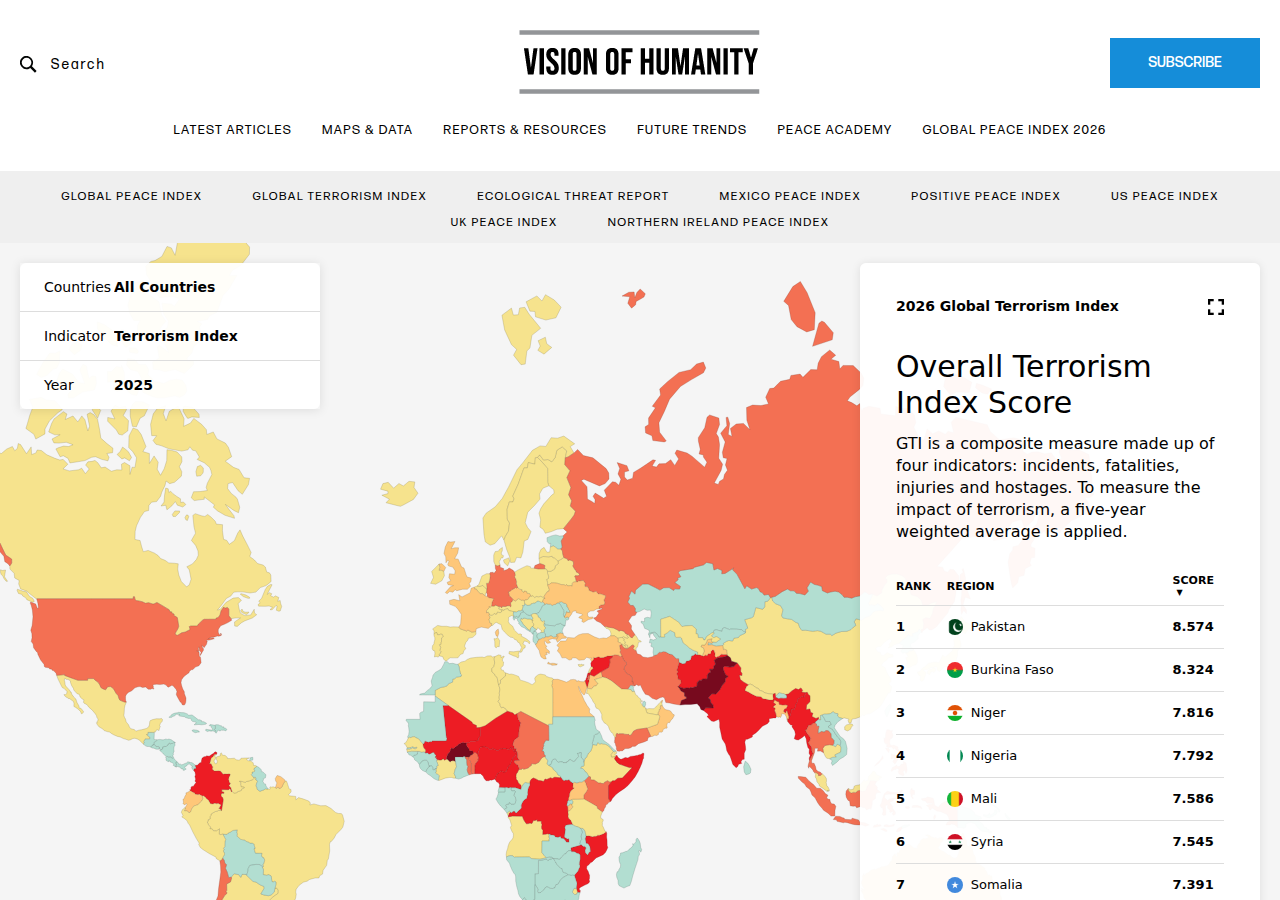
For this analysis, we use the GTD definition and cross-reference with the Institute for Economics and Peace (IEP) Global Terrorism Index.
Global Statistics: Scale and Trends
Source: IEP Global Terrorism Index 2023; GTD (START, University of Maryland)
| Year | Global Deaths from Terrorism |
|---|---|
| 2007 | ~12,800 |
| 2012 | ~15,500 |
| 2014 | ~33,555 (peak — dominated by IS in Iraq/Syria + Boko Haram in Nigeria) |
| 2016 | ~25,600 |
| 2018 | ~15,952 |
| 2020 | ~13,826 |
| 2022 | ~6,701 |
The peak in 2014 was driven primarily by the Islamic State (IS) seizing large territories in Iraq and Syria and by Boko Haram's peak activity in northeastern Nigeria. The subsequent decline reflects military campaigns against IS and Boko Haram, not a reduction in the underlying ideology.
Geographic concentration: In 2022, five countries accounted for approximately 80% of global terrorism deaths: Burkina Faso, Mali, Somalia, Nigeria, and Iraq. All five countries are experiencing active Islamist insurgencies as the primary driver of terrorism deaths.
Terrorism by Ideology: The Global Breakdown
Estimated share of global terrorism deaths 2000–2022 by primary ideology of perpetrators:
| Ideology | Est. Share of Global Deaths | Primary Groups / Notes |
|---|---|---|
| Islamist (jihadist) | ~65–75% | IS, Al-Qaeda, Taliban, Boko Haram/ISWAP, Al-Shabaab, JNIM, TTP, Lashkar-e-Taiba, JeM, ASG |
| Nationalist / separatist (non-religious) | ~8–12% | FARC (Colombia), PKK (Kurdish), Naxalites/Maoist (India), various ethnic militias |
| Far-right / white nationalist | ~2–5% globally; higher in Western democracies | Breivik (Norway), Tarrant (NZ), McVeigh (US), Roof/Bowers/Crusius (US) |
| Communist / far-left | ~3–6% | Sendero Luminoso (Peru), FARC, various South Asian groups |
| Religious (other) | ~1–3% | Sikh separatists (Khalistan), Aum Shinrikyo (Japan), LRA (Uganda — syncretic Christian militia) |
| Unknown / other | ~5–8% | Unaffiliated or unclaimed incidents |
Notes on this data:
- "Islamist" here means groups that explicitly justify their violence through Islamic scripture and/or declare the goal of establishing Islamic governance (caliphate, sharia state). This is not a statement about all Muslims or Islam as a religion — it is a description of what these groups state as their motive.
- The dominance of Islamist groups in the death count is especially pronounced because of the scale of individual attacks: the 9/11 attacks (2,977 deaths), the IS campaign in Iraq/Syria (tens of thousands), and Boko Haram's prolonged insurgency in Nigeria (estimated 350,000+ deaths from 2009–2022 including conflict deaths) dwarf any single far-right incident.
- In Western democracies specifically, the far-right domestic terrorism share is significantly higher — roughly 25–35% of deaths from terrorism in Western Europe and North America (2001–2022), with Islamist attacks accounting for the majority of deaths in that region.
- The FBI's 2022 Domestic Terrorism report identified Racially/Ethnically Motivated Violent Extremism (REMVE — primarily white supremacist) and Anti-Government Extremism as the two largest categories of domestic terrorism cases in the United States by case count. International (Islamist) terrorism produced more mass-casualty events in the same period.
Source: IEP Global Terrorism Index 2023; GTD (START, University of Maryland 2021); RAND Corporation, "Trends in Global Terrorism" (2017); FBI Terrorism Statistics (2022).
Top Terrorist Organizations by Global Deaths (2000–2022)
| Group | Ideology | Primary Region | Est. Deaths Caused (2000–2022) | Notes |
|---|---|---|---|---|
| Islamic State (IS/ISIS/ISIL/Daesh) | Sunni jihadist | Iraq, Syria, Africa, global affiliates | 50,000–100,000+ | Peaked 2013–2017; held territory the size of the UK; enforced stoning, crucifixion, beheadings |
| Taliban | Sunni Deobandi Islamist | Afghanistan, Pakistan | 30,000–70,000+ | Governed Afghanistan 1996–2001 and 2021–present |
| Boko Haram / ISWAP | Sunni jihadist | Nigeria, Chad, Niger, Cameroon | 30,000–60,000+ | Name means "Western education is forbidden" |
| Al-Shabaab | Sunni jihadist | Somalia, Kenya, East Africa | 15,000–25,000+ | Affiliated with Al-Qaeda |
| Al-Qaeda / AQ affiliates | Sunni jihadist | Global | 20,000–40,000+ | Includes AQAP, AQIM, Al-Nusra/HTS |
| JNIM (Jama'at Nusrat al-Islam wal-Muslimin) | Sunni jihadist | Mali, Burkina Faso, West Africa | 5,000–15,000+ | Al-Qaeda affiliate; dominant in Sahel |
| TTP (Tehrik-i-Taliban Pakistan) | Sunni jihadist | Pakistan, Afghanistan | 10,000–20,000+ | |
| Hezbollah | Shia Islamist | Lebanon, Syria, globally | 5,000–15,000+ | State-sponsored by Iran; designated terrorist by US, EU |
| Hamas | Sunni Islamist | Gaza, Israel | 5,000–10,000+ | Includes Oct 7, 2023 attack |
| Naxalites / CPI(M) | Communist/Maoist | India (rural central states) | 5,000–10,000+ | Long-running insurgency |
| FARC | Communist/nationalist | Colombia | 3,000–8,000+ | Largely disarmed 2016 peace deal; FARC dissidents continue |
| PKK | Kurdish nationalist / Marxist | Turkey, Iraq, Syria | 3,000–8,000+ | Designated terrorist by US/EU |
| Lashkar-e-Taiba (LeT) | Sunni Islamist | Pakistan, India | 3,000–6,000+ | Mumbai 2008; ISI ties |
Death estimates are approximate, compiled from GTD, ACLED, IEP, and conflict tracking databases. They include combatant and civilian deaths from terrorist acts attributed to these groups.
Major International Terror Attacks: Documented Record
This table covers attacks with 10+ deaths or historically significant attacks in Western countries. It is illustrative, not exhaustive. Complete data: Global Terrorism Database (200,000+ incidents, 1970–2020).
| Date | Location | Perpetrators | Method | Deaths | Injuries | Group / Ideology | Claimed or Deduced |
|---|---|---|---|---|---|---|---|
| Sep 11, 2001 | New York, DC, Pennsylvania, USA | 19 Al-Qaeda operatives (15 Saudi, 2 UAE, 1 Egyptian, 1 Lebanese nationals) | 4 aircraft used as missiles | 2,977 | ~6,000 | Al-Qaeda — Sunni jihadist | Claimed (bin Laden video, Oct 2004) |
| Oct 12, 2002 | Bali, Indonesia | Jemaah Islamiyah (Imam Samudra, Amrozi, Mukhlas) | Car bomb + suicide bomb at nightclubs | 202 | 209 | Jemaah Islamiyah — Sunni jihadist (Al-Qaeda affiliate) | Convicted; group confirmed |
| Mar 11, 2004 | Madrid, Spain | Al-Qaeda cell (10 bombers, Moroccan/Syrian nationals) | 10 coordinated train bombings | 191 | ~2,000 | Al-Qaeda affiliated — Sunni jihadist | Claimed (Al-Qaeda video) |
| Sep 1–3, 2004 | Beslan, Russia | ~32 Islamist militants (Chechens + Ingush) | School siege, explosives, shooting | 334 (186 children) | 783 | Riyadus-Salikhin (Chechen Islamist) — Sunni jihadist | Claimed (Shamil Basayev) |
| Jul 7, 2005 | London, UK | 4 suicide bombers (3 British-Pakistani, 1 Jamaican-British) | Subway + bus bombs | 52 | 700+ | Al-Qaeda inspired — Sunni jihadist | Video manifestos; Al-Qaeda claimed |
| Jun 23, 1985 | Atlantic Ocean (Air India Flt 182) | Sikh separatists (Inderjit Singh Reyat et al.) | Suitcase bomb | 329 | 0 (all killed) | Khalistan movement — Sikh nationalist | Convicted |
| Nov 26–29, 2008 | Mumbai, India | 10 Lashkar-e-Taiba operatives (Pakistani nationals) | Coordinated armed assault, bombs | 166 | 300+ | Lashkar-e-Taiba — Sunni jihadist | Phone intercepts confirmed; Pakistani trial |
| Jul 22, 2011 | Oslo + Utøya, Norway | Anders Behring Breivik (Norwegian) | Car bomb + island massacre | 77 | 319 | Far-right, anti-Islam, Islamophobic | Manifesto published before attack |
| Sep 21–24, 2013 | Nairobi, Kenya (Westgate Mall) | Al-Shabaab (Kenya-based cell) | Armed assault | 67 | 175 | Al-Shabaab — Sunni jihadist (Al-Qaeda affiliate) | Claimed |
| Apr 2, 2015 | Garissa University, Kenya | Al-Shabaab (5 attackers) | Armed assault, targeted non-Muslims | 147 | 79 | Al-Shabaab — Sunni jihadist | Claimed |
| Jan 7–9, 2015 | Paris, France (Charlie Hebdo + Hyper Cacher) | Said + Chérif Kouachi; Amedy Coulibaly (French nationals, Algerian origin) | Armed assault | 17 | 22 | AQAP (Charlie Hebdo); IS (supermarket) | Claimed (video); AQAP confirmed |
| Nov 13, 2015 | Paris, France (Bataclan, Stade de France, restaurants) | 10 IS operatives (Franco-Belgian cell) | Suicide bombs + armed assault | 130 | 413 | Islamic State — Sunni jihadist | Claimed (official IS statement) |
| Mar 22, 2016 | Brussels, Belgium (airport + metro) | 3 IS operatives (Belgian nationals, Moroccan origin) | Suicide bombs | 32 | 340+ | Islamic State — Sunni jihadist | Claimed |
| Jun 12, 2016 | Orlando, FL, USA (Pulse nightclub) | Omar Mateen (US citizen, Afghan parentage) | Mass shooting | 49 | 53 | IS inspired — Sunni jihadist | Pledged to IS in 911 call during attack |
| Jul 14, 2016 | Nice, France (Bastille Day crowd) | Mohamed Lahouaiej-Bouhlel (Tunisian national) | Truck ramming | 86 | 458 | IS inspired — Sunni jihadist | Claimed by IS; evidence of IS contact |
| Dec 19, 2016 | Berlin, Germany (Christmas market) | Anis Amri (Tunisian national) | Truck ramming | 12 | 48 | IS inspired — Sunni jihadist | Claimed by IS |
| May 22, 2017 | Manchester, UK (Ariana Grande concert) | Salman Abedi (British-Libyan) | Suicide bomb | 22 | 1,017+ | IS inspired — Sunni jihadist | Claimed by IS; Abedi's Libya-IS ties confirmed |
| Jun 3, 2017 | London, UK (London Bridge + Borough Market) | 3 attackers (Khuram Butt et al.) | Van ramming + stabbing | 8 | 48 | IS inspired — Sunni jihadist | Claimed by IS |
| Aug 17, 2017 | Barcelona, Spain (Las Ramblas) | IS-inspired cell of 8 (Moroccan + Spanish nationals) | Van ramming | 13 | 130+ | IS inspired — Sunni jihadist | Claimed by IS |
| Apr 21, 2019 | Colombo, Sri Lanka (Easter bombings) | National Thowheeth Jama'ath suicide bombers | Suicide bombs at 3 churches + 3 hotels | 269 | 500+ | National Thowheeth Jama'ath / IS affiliate | Claimed by IS |
| Mar 15, 2019 | Christchurch, New Zealand | Brenton Tarrant (Australian) | Mass shooting at 2 mosques | 51 | 40 | Far-right, white nationalist | Livestreamed; 74-page manifesto |
| Oct 7, 2023 | Southern Israel (kibbutzim + Nova festival) | ~3,000 Hamas + PIJ operatives | Armed assault, mass hostage-taking | ~1,200 (deadliest day for Jews since Holocaust) | ~5,400 | Hamas — Sunni Islamist | Claimed; Hamas leadership celebrated |
| Aug 15, 1998 | Omagh, Northern Ireland | Real IRA | Car bomb in town center | 29 | 220+ | Real IRA — Irish Republican nationalist | Claimed (then denied) |
Major US Domestic Terror Attacks
| Date | Location | Perpetrators | Method | Deaths | Injuries | Ideology | Claimed or Deduced |
|---|---|---|---|---|---|---|---|
| Apr 19, 1995 | Oklahoma City, OK | Timothy McVeigh + Terry Nichols | Truck bomb (federal building) | 168 (19 children) | 680+ | Far-right, anti-government, Christian Identity influenced | McVeigh's own statements; conviction |
| Sep 11, 2001 | New York, DC, Pennsylvania | Al-Qaeda (see above) | — | 2,977 | — | Islamist | — |
| Apr 15, 2013 | Boston, MA (marathon) | Dzhokhar + Tamerlan Tsarnaev (Chechen-American) | Pressure cooker bombs | 3 | 264 | Islamist — Al-Qaeda inspired | Video message; Tsarnaev's own statements at trial |
| Nov 5, 2009 | Fort Hood, TX (military base) | Nidal Malik Hasan (US Army Major) | Shooting | 13 | 30+ | Islamist — correspondence with Anwar al-Awlaki (AQAP) | Self-identification; FBI evidence |
| Dec 2, 2015 | San Bernardino, CA (county office) | Syed Rizwan Farook + Tashfeen Malik (Pakistani national) | Shooting | 14 | 22 | IS inspired — Sunni jihadist | Facebook pledge of allegiance to IS |
| Jun 17, 2015 | Charleston, SC (Emanuel AME Church) | Dylann Roof | Mass shooting | 9 | 1 | White nationalist, antisemitic | Racist manifesto; Roof's own statements |
| Jun 12, 2016 | Orlando, FL (Pulse nightclub) | Omar Mateen (US citizen) | Mass shooting | 49 | 53 | IS inspired | Pledged to IS in 911 call; see above |
| Oct 1, 2017 | Las Vegas, NV (concert) | Stephen Paddock | Shooting from hotel window | 60 | 413 | Unknown — motive not established | No manifesto; FBI found no terrorism link |
| Oct 27, 2018 | Pittsburgh, PA (Tree of Life Synagogue) | Robert Bowers | Shooting | 11 | 7 | Far-right, antisemitic | Gab posts before attack |
| Aug 3, 2019 | El Paso, TX (Walmart) | Patrick Crusius | Mass shooting | 23 | 22 | Far-right, anti-immigrant, white nationalist | Manifesto posted before attack |
| Jul 16, 2015 | Chattanooga, TN (military recruiting centers) | Mohammod Youssuf Abdulazeez (Kuwaiti-American) | Shooting | 5 | 2 | IS inspired | Deduced from writings and IS connection |
| Oct 31, 2017 | New York, NY (bike path) | Sayfullo Saipov (Uzbek national, legal resident) | Truck ramming | 8 | 11 | IS inspired | Note left; self-identification |
| Jan 6, 2021 | Washington, DC (US Capitol) | Multiple actors | Riot, assault | 1 direct (Ashli Babbitt, shot) / 4 officers died | ~140 officers injured | Far-right, political; disputed "terrorism" classification | Coordinated groups (Proud Boys, Oath Keepers); ongoing prosecutions |
Note: Jan 6, 2021 is included as an event that multiple prosecutors and legal bodies have described as involving elements of terrorism; whether it constitutes terrorism per the formal definition is legally contested.
Terrorism by Country of Origin of Perpetrators
For international attacks in Western countries (US, UK, EU, Australia) from 2001–2022:
| Country of Origin | Notable Attacks / Contribution |
|---|---|
| Saudi Arabia | 15 of 19 Sept 11 hijackers; significant Al-Qaeda financing and leadership |
| Pakistan | Mumbai 2008 (Lashkar-e-Taiba); multiple UK attackers (7/7 British-Pakistani); Farhan Khalid (various plots); TTP |
| Morocco | Multiple operatives in Madrid 2004, Brussels 2016, Barcelona 2017, Molenbeek network |
| Tunisia | Nice truck attacker (Lahouaiej-Bouhlel); Berlin truck attacker (Amri); multiple IS foreign fighters |
| Algeria | AQIM; significant share of Paris network; colonial history with France |
| Libya | Manchester bomber Salman Abedi (British-Libyan); IS Libya affiliate |
| Chechnya / Russia | Boston marathon (Tsarnaev brothers); Beslan; multiple European plots |
| Afghanistan | Taliban; Al-Qaeda sanctuary |
| Somalia | Al-Shabaab; multiple US/UK individuals radicalized in diaspora |
| Egypt | Al-Qaeda intellectual leadership (Zawahiri); historically significant |
| Iraq / Syria | IS foreign fighters returning to Western countries; IS attacks within these territories |
| Nigeria | Boko Haram; "Underwear bomber" Umar Farouk Abdulmutallab (Nigerian, AQAP trained) |
| Yemen | Al-Qaeda in the Arabian Peninsula (AQAP); Christmas Day 2009 plot; Charlie Hebdo connection |
For US domestic terrorism (2000–2022):
- Born in the United States: The majority of both far-right domestic terrorism perpetrators and Islamist-inspired terrorism perpetrators in the US were US citizens or legal residents at the time of their attack (Fort Hood, Orlando, San Bernardino*, Boston*, Oklahoma City).
- *Farook was US-born; Malik was a Pakistani national with a K-1 visa. Tsarnaev was a naturalized citizen.
- Far-right domestic: McVeigh, Roof, Bowers, Crusius — all US-born citizens.
Key finding: The "foreign-born terrorism" framing captures some attacks (9/11 pilots, Nice, Berlin) but misses the significant portion of Islamist-inspired attacks carried out by citizens of Western countries who radicalized domestically or via online networks.
The "Terrorism Has No Religion" Claim: What the Data Says
The claim: "Terrorism has no religion" — often cited in the aftermath of Islamist attacks, implying that the perpetrators' religious ideology is irrelevant or incidental to their violence.
What the data shows:
-
The groups themselves explicitly state their religious motivation. The Islamic State published a theological journal (Dabiq, later Rumiyah) explaining its scriptural justification for every act. Al-Qaeda's declarations were built around fatwas. Boko Haram's name translates roughly to "Western education is sin/forbidden" in Hausa. These are not analysts attributing religion retroactively — these are the groups' own stated reasons.
-
The death toll is not equally distributed across ideologies. Between 2001 and 2022, Islamist groups were responsible for an estimated 65–75% of global terrorism deaths. No other ideological category comes close at the global level.
-
"Religion" vs. "Islam": The claim is sometimes made more precisely: not that religion is irrelevant but that the perpetrators are "perverting" Islam. This is a theological argument, not an empirical one. Whether they are correctly interpreting Islam is a matter of religious scholarship — but what they believe they are doing is a matter of documented fact.
-
The false equivalence with far-right domestic terrorism: In Western domestic contexts, far-right terrorism is a genuine and growing threat. This does not make it equivalent in scale to global Islamist terrorism. In terms of deaths globally: Islamist attacks produced roughly 10–20× more deaths than far-right attacks in the same period.
-
Not all perpetrators are devout Muslims. Several Islamist attackers (Omar Mateen, Mohamed Lahouaiej-Bouhlel) were documented to have been personally non-devout, had histories of substance use or sexual behavior inconsistent with strict Islam, and radicalized rapidly before their attacks. This complicates but does not eliminate the ideological factor — they self-identified with the ideology at the moment of the attack.
Counter-arguments that have merit:
- Most Muslims do not engage in terrorism, and most victims of Islamist terrorism are Muslims in Muslim-majority countries.
- Structural and geopolitical factors (colonial history, Western military interventions, failed states) contribute to radicalization — ideology is not the only variable.
- Labeling terrorism by religion when applied selectively ("Islamic terrorism" but not "Christian terrorism" for the IRA or LRA) introduces inconsistency.
These counter-arguments do not invalidate the primary data finding: that Islamist ideology, as a stated and documented motivation, accounts for the majority of global terrorism deaths.
Sources and Databases
- Global Terrorism Database (GTD) — National Consortium for the Study of Terrorism and Responses to Terrorism (START), University of Maryland. The most comprehensive academic terrorism database: 200,000+ incidents from 1970–2020, with detailed coding for perpetrator, ideology, method, casualties.
- IEP Global Terrorism Index 2023 — Annual report from the Institute for Economics and Peace; tracks deaths, incidents, and trends by country and group.
- ACLED (Armed Conflict Location and Event Data Project) — Real-time conflict tracking; especially strong for sub-Saharan Africa and Asia.
- FBI Terrorism Statistics — US domestic and international terrorism statistics.
- RAND Terrorism Database — Academic analysis with longer-term trend data.
- UN Office of Counter-Terrorism (UNOCT) — UN-level monitoring and definition framework.
- Europol TE-SAT (EU Terrorism Situation and Trend Report) — Annual EU-wide terrorism statistics including domestic and Islamist trends.
- MEMRI (Middle East Media Research Institute) — Translation and documentation of primary source materials from Islamist groups.
- SITE Intelligence Group — Real-time monitoring of terror group communications and claims.