
"Islam Is Compatible with Homosexuality": What the Quran, Hadith, and Islamic Law Actually Say
The claim that Islam is compatible with homosexuality — sometimes made to draw a contrast with perceived Western hostility toward Muslims — does not survive contact with Islamic primary sources. All four major Sunni schools of jurisprudence and the Shia tradition prescribe criminal punishment for same-sex acts, up to and including death. Eleven countries enforce the death penalty for homosexuality; all are Muslim-majority. The Organization of Islamic Cooperation (OIC) — the 57-state body representing the Muslim world — has systematically blocked every UN effort to extend human rights protections to LGBTQ people. Individual Muslims may hold diverse personal views, but the legal and scriptural tradition of Islam is not ambiguous on this question.
In progressive Western discourse, Islam is sometimes described as a religion whose relationship to homosexuality is nuanced, open to interpretation, or compatible with modern LGBTQ rights. This claim is made in good faith by people who know individual Muslims who are personally accepting of gay people, or who argue that scriptural interpretation is always contested.
The claim does not survive contact with the primary sources of Islamic law, the documented legal positions of the institutions that govern Islam's major traditions, or the laws of countries governed by those traditions.
What the Quran Says
The Quran addresses male homosexuality in multiple passages, all in the context of the story of Lot (called Lut in Arabic — the same figure as in Genesis). The passages are unambiguous in their condemnation:
Quran 7:80–84: "And Lot, when he said to his people: 'Do you commit such immorality as no one has preceded you with from among the worlds? Indeed, you approach men with desire, instead of women. Rather, you are a transgressing people.' And the answer of his people was not but that they said: 'Expel them from your city; indeed, they are men who keep themselves pure.' So We saved him and his family, except for his wife; she was of those who remained behind. And We rained upon them a rain [of stones]. Then see how was the end of the criminals."
Quran 26:165–166: "Do you approach males among the worlds and leave what your Lord has created for you as mates? But you are a transgressing people."
Quran 27:54–55: "And Lot, when he said to his people, 'Do you commit immorality while you are seeing? Do you indeed approach men with desire instead of women? Rather, you are a people behaving ignorantly.'"
These passages are not metaphorical or contextually ambiguous in Islamic exegesis. Classical and contemporary Islamic scholars across all major traditions read them as a clear prohibition on same-sex acts between men.
What the Hadith Say
The hadith literature (recorded sayings and acts of the Prophet Muhammad) is equally explicit. Several hadith directly address punishment:
Abu Dawud 4462: The Prophet said regarding a man found with another man in the act of the people of Lot: execute both.
Ibn Majah 2561: "Whoever you find doing the act of the people of Lot, execute the one who does it and the one to whom it is done."
Tirmidhi 1456: Similar prescription for punishment.
These are classified as authentic (sahih or hasan) by classical hadith scholarship. They form the basis for the prescriptions in classical Islamic jurisprudence.
What Islamic Law (Fiqh) Says
Islamic jurisprudence developed across four major Sunni schools (madhabs) and the Shia tradition. All five hold that male homosexual acts are forbidden (haram) and all prescribe punishment, though they differ on the specific penalty:
Hanafi school (largest globally, dominant in Turkey, South Asia, Central Asia): The act is forbidden and subject to ta'zir (discretionary punishment) — the death penalty is not the prescribed hadd punishment under classical Hanafi doctrine, but serious punishment applies.
Maliki school (dominant in North and West Africa): Death penalty is the prescribed punishment for both the active and passive partner, whether married or unmarried.
Shafi'i school (dominant in East Africa, Southeast Asia, parts of Middle East): Death penalty prescribed, generally by stoning.
Hanbali school (dominant in Saudi Arabia): Death penalty by stoning.
Shia (Ja'fari) tradition: Death for the active partner; 100 lashes for the passive partner on the first two offenses; death on the third.
No major classical school of Islamic jurisprudence holds that male homosexual acts are permitted. The debate within classical Islamic scholarship is about what penalty applies, not whether the acts are forbidden.
Which Countries Enforce the Death Penalty for Homosexuality
According to ILGA World (International Lesbian, Gay, Bisexual, Trans and Intersex Association), which tracks state-sponsored homophobia globally, 11 countries enforce the death penalty for consensual same-sex acts. All 11 are Muslim-majority:
| Country | Legal Basis |
|---|---|
| Iran | Islamic Penal Code |
| Saudi Arabia | Sharia law |
| Yemen | Penal Code based on sharia |
| Qatar | Penal Code based on sharia |
| United Arab Emirates | Federal Penal Code + emirate laws |
| Afghanistan | Taliban interpretation of sharia |
| Mauritania | Penal Code based on sharia |
| Pakistan | Section 377 + Federal Shariat Court |
| Nigeria | Penal Code (northern sharia states) |
| Sudan | Criminal Act based on sharia |
| Brunei | Sharia Penal Code |
An additional 60+ countries criminalize homosexuality, the majority of which are Muslim-majority or have legal codes derived from Islamic law.
Not all Muslim-majority countries enforce the death penalty — Turkey, Jordan, Kosovo, Albania, Tunisia (in practice), and others do not criminalize homosexuality. But the countries that do impose the death penalty are exclusively Muslim-majority.
The OIC: Institutional Islam on LGBTQ Rights
The Organization of Islamic Cooperation (OIC) is the second-largest intergovernmental organization in the world after the UN, with 57 member states representing approximately 1.8 billion Muslims. It is the closest thing the Muslim world has to a collective institutional voice.
At the United Nations Human Rights Council, the OIC bloc has:
- Voted against every resolution extending non-discrimination protections to LGBTQ people
- Consistently opposed the appointment of the UN Independent Expert on Sexual Orientation and Gender Identity
- Issued formal statements that extending human rights to LGBTQ people contradicts Islamic values and should not be part of international human rights law
- Blocked consensus on multiple resolutions by arguing that there is no internationally recognized right based on sexual orientation
This is not the position of individual Muslims — it is the institutional position of the organized body representing the governments of Muslim-majority states, acting collectively at the world's primary human rights forum.
What Individual Muslim Views Are
Pew Research surveys of Muslim-majority countries consistently find extremely high opposition to homosexuality among Muslim populations:
-
In the 2013 Pew survey "The World's Muslims," the percentage saying homosexuality is morally acceptable:
- Turkey: 4% acceptable / 78% unacceptable
- Egypt: 3% / 95%
- Jordan: 3% / 97%
- Pakistan: 2% / 87%
- Indonesia: 3% / 93%
- Senegal: 1% / 98%
- Malaysia: 3% / 89%
-
Among American Muslims in 2023 Pew surveys, attitudes have shifted significantly — approximately 52% say homosexuality should be accepted, reflecting the influence of the secular American cultural environment on diaspora communities.
The divergence between American Muslim views and global Muslim views is striking. American Muslims have adopted views that are dramatically more accepting than their co-religionists worldwide, reflecting acculturation to US norms rather than Islamic scriptural tradition. Using American or Western European Muslim views to characterize "what Islam says" about homosexuality produces a picture that is not representative of the global Muslim population or the legal tradition.
The \"Interpretation\" Response
The standard counter-argument is that Islamic scripture, like all religious texts, is subject to interpretation, and that progressive Muslim scholars interpret these passages differently. This is true at the level of individual theology — some Muslim scholars do argue for a more accepting interpretation.
However:
- These scholars are a tiny minority within Islamic scholarship, hold no institutional authority in any major Muslim-majority country, and their views are rejected by the dominant institutions of Sunni and Shia Islam.
- The interpretive tradition across 1,400 years of Islamic scholarship is, on this question, essentially unanimous. Claiming that the tradition is "open to interpretation" on homosexuality is like claiming that the Catholic Church's tradition is "open to interpretation" on the resurrection — theoretically a scholar could argue it, but it is not representative of what the tradition holds.
- Progressive reinterpretations of the Quran and hadith passages on homosexuality typically require arguing that the prohibition applies only to a specific cultural context (ancient Sodom) and not to loving committed relationships. This interpretation is not accepted by any major traditional Islamic legal institution.
The comparison that clarifies this: if someone said "Christianity is compatible with abortion because some Christians support it," most people would recognize this as conflating individual Christian views with the doctrinal position of the tradition. The same framework should apply here.
Country-by-Country: The Laws, Methods, and Documented Cases
Below is each country that enforces the death penalty for homosexuality — the specific law and article, the prescribed or documented execution method, and a link to the primary legal text where available.
🇮🇷 Iran — Hanging (cranes and gallows)
Law: Islamic Penal Code (2013), Article 233–234
Article 233 prescribes death for lavat (penetrative male homosexual sex) for both the active and passive partner if both are adult, sane, and consenting. Article 236 prescribes 100 lashes for tafkhiz (non-penetrative same-sex acts between men).
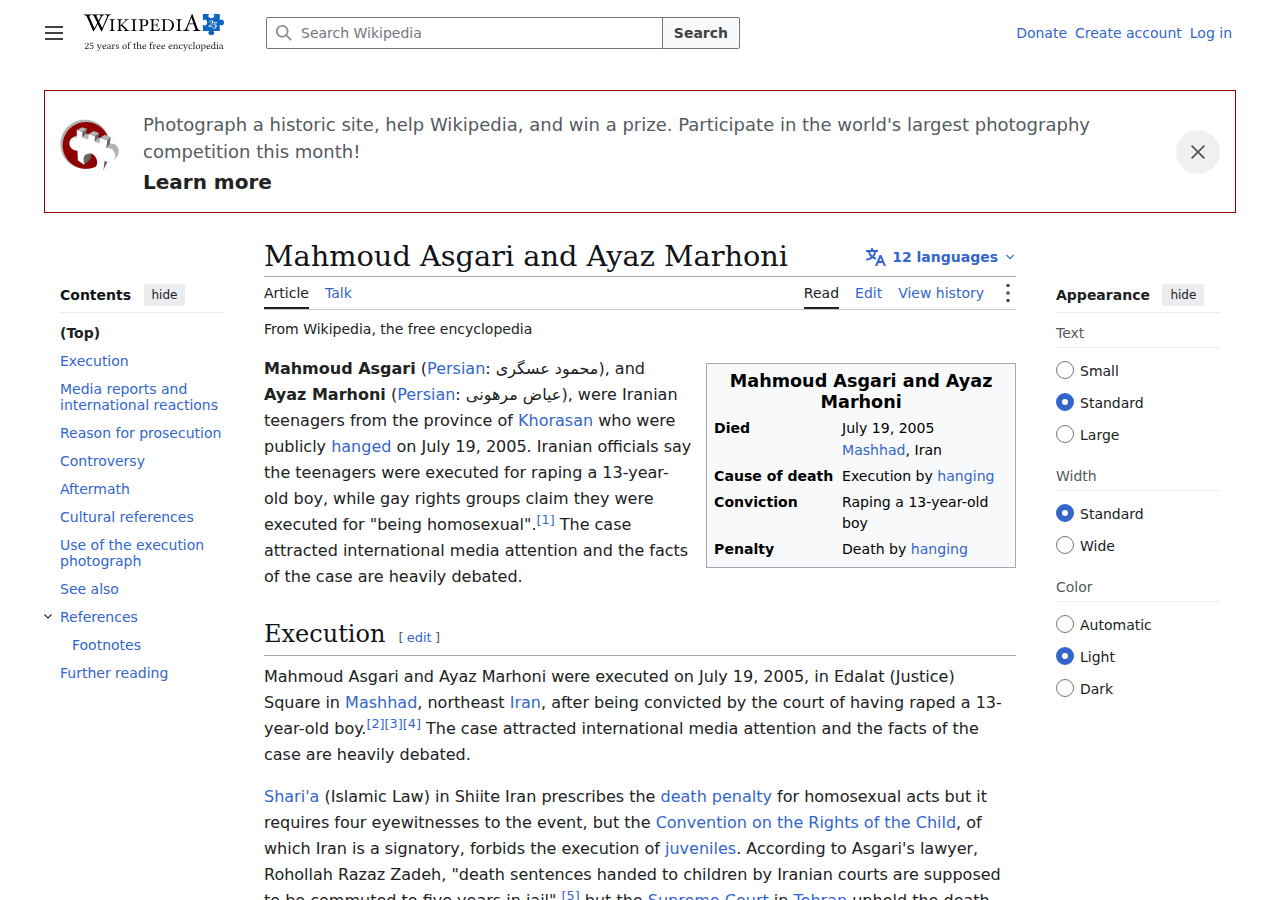
Method: Hanging. Iran uses both conventional gallows and, distinctively, mobile construction cranes erected in public squares and intersections. The condemned are suspended by a noose attached to the crane arm, often in full public view, sometimes with crowds present. In 2005, Mahmoud Asgari (16) and Ayaz Marhoni (18) were publicly hanged in Mashhad in a case that drew international condemnation. Photographs of the hanging were published by international news outlets. Iran executed an estimated 4,000–6,000 people for homosexuality between 1979 and 2008 according to human rights organizations; precise current figures are difficult to verify because Iran classifies many executions under charges like "corruption on earth" or rape rather than publishing them as homosexuality executions.
Documented: Amnesty International, Human Rights Watch, and the Iranian Human Rights Documentation Center have documented dozens of cases with photographs and court records.
🇸🇦 Saudi Arabia — Beheading, stoning, or flogging (judge-discretionary)
Law: Saudi Arabia has no written statutory penal code for homosexuality. Judges apply their interpretation of the Hanbali school of Islamic jurisprudence directly. The Hanbali school prescribes death by stoning for liwat (penetrative homosexual acts).
Saudi courts have sentenced men to beheading and stoning for homosexuality, sometimes combined with other charges. The absence of a written code means penalties vary by judge and by whether the accused is Saudi (who may be executed) or foreign (who may be deported after flogging and imprisonment).
Method: Beheading by sword (Saudi Arabia's standard execution method for all capital offenses), or stoning.
Documented: Human Rights Watch has documented Saudi executions under this framework. The precise number is unknown because Saudi Arabia does not publish statistics by charge category. Foreign workers — particularly South and Southeast Asian migrants — are frequently deported after imprisonment rather than executed.
[Saudi Arabia has no publicly accessible consolidated criminal code for this offense; applications of sharia law are judge-discretionary.]
🇾🇪 Yemen — Execution (death by various means)
Law: Penal Code, Article 264 — liwat (male homosexual penetration) is punishable by death for a muhsan (married or previously married) man. An unmarried man receives 100 lashes and one year in prison.
Method: Execution method is not specified in statute; in practice this has meant shooting or hanging.
Note: Yemen is currently a failed state with competing factions (Houthis in the north, internationally recognized government in the south). Enforcement exists in both territories; the Houthis, as an Islamist movement, apply a strict interpretation of sharia law.
🇦🇫 Afghanistan — Stoning; walls collapsed on condemned; shooting
Law: Under Taliban rule (August 2021–present), there is no written penal code. The Taliban applies its interpretation of sharia law by decree. Under the Taliban's first period in power (1996–2001), male homosexuality was punishable by death; that policy was reinstated after the 2021 takeover.
Method: The Taliban has used multiple documented methods:
- Stoning: the classical Islamic hadd punishment for liwat
- Wall collapse: in multiple documented cases from the first Taliban period, men convicted of homosexuality were taken to the foot of a mud-brick wall, the wall was pushed onto them with a tank or by hand, and they were left buried. If they survived for 30 minutes, some Taliban judges ruled they could go free — in practice, survival was unlikely.
- Shooting: used in some cases after 2021
The wall-collapse method was documented by journalists and human rights organizations during the 1996–2001 period. Cases of men being thrown from buildings have been more consistently documented in areas controlled by ISIS/ISIL in Syria and Iraq (2014–2018), which used their own propaganda footage to publicize these executions. The Taliban uses the same underlying jurisprudence but has preferred stoning and wall collapse.
Documented: Human Rights Watch documented wall-collapse executions in Afghanistan during the 1990s. The UN Assistance Mission in Afghanistan (UNAMA) has documented post-2021 executions including for homosexuality.
🇲🇷 Mauritania — Death by stoning
Law: Penal Code, Law 84-017 (1984), Article 308 — death by public stoning for Muslim men who engage in same-sex acts. Non-Muslim men may receive prison sentences.
Method: Death by stoning. Mauritania has not publicly confirmed a confirmed execution for homosexuality in recent years, but the law remains in force and individuals have been arrested and imprisoned under it.
🇵🇰 Pakistan — Death by stoning (theoretical); typically imprisonment
Law: Two parallel frameworks:
- Pakistan Penal Code Section 377 (colonial-era law): "carnal intercourse against the order of nature" — imprisonment from 2 years to life, or fine, or both. Does not specify death.
- Offence of Zina (Enforcement of Hudood) Ordinance, 1979: Under hudood law, liwat is punishable by 100 lashes or death by stoning if the accused is married.
Method: Death by stoning under the Hudood Ordinance. In practice, Pakistan's courts have imposed imprisonment under Section 377 rather than death under Hudood; actual executions for homosexuality are not well-documented, though arrests and imprisonments are.
Note: Pakistan is classified as a death-penalty country by ILGA due to the Hudood Ordinance, though the practical enforcement pattern is imprisonment rather than execution.
🇳🇬 Nigeria (12 northern states) — Death by stoning
Law: Nigeria's federal same-sex prohibition (Same Sex Marriage (Prohibition) Act 2014) does not prescribe the death penalty. The death penalty applies in 12 northern states that have enacted sharia penal codes since 1999–2000:
States: Bauchi, Borno, Gombe, Jigawa, Kaduna, Kano, Katsina, Kebbi, Niger, Sokoto, Yobe, Zamfara.
Example: Kano State Sharia Penal Code, Section 128 — liwat for a married man = death by stoning.
Method: Death by stoning under state sharia codes.
Documented: Nigeria has had multiple cases of men sentenced to death by stoning under state sharia codes. International pressure has sometimes led to sentences being reduced; no confirmed execution for homosexuality specifically is documented in recent years, though the law remains in force.
🇶🇦 Qatar — Death (rarely enforced; deportation common)
Law: Qatar Penal Code 2004 (Law No. 11 of 2004), Article 285 — liwat between consenting adult men: up to 7 years imprisonment. Under Sharia interpretation applicable to Muslims, the death penalty applies in certain circumstances (penetrative acts by married men).
Method: Death (applicable under sharia for married men); in practice, Qatar most commonly imprisons and deports foreigners. Qatar's population is approximately 88% non-citizen migrant workers, and most homosexuality cases involve foreigners who are deported.
Note: Qatar drew international attention hosting the 2022 FIFA World Cup while maintaining this law. Tournament organizers assured visitors that LGBTQ people would be "welcome" — while Qatari law remained unchanged.
🇦🇪 UAE — Death (under emirate laws and sharia; federal law: imprisonment)
Law: Federal level: UAE Penal Code, Federal Law No. 3 of 1987, Article 354 — consensual sodomy between men: up to 1 year imprisonment. Individual emirates add penalties through their own penal codes:
- Abu Dhabi: sharia court jurisdiction can impose death
- Dubai: up to 1 year imprisonment under Dubai Penal Code (Decree No. 3 of 1987)
- Sharia courts in Abu Dhabi and Sharjah can impose death under their interpretation of Islamic law
Method: Death (under sharia courts in emirates where applicable); in practice, UAE typically imprisons and deports foreigners.
Note: The UAE, like Qatar, hosts large numbers of Western expatriates and presents internationally as a modern, tolerant country while maintaining these laws.
🇸🇩 Sudan — Death by stoning
Law: Sudan Criminal Act 1991, Article 148 — liwat (penetrative homosexual acts): 100 lashes for first offense; 100 lashes and imprisonment for second offense; death by stoning for third offense, or for a married man on the first offense.
Method: Death by stoning.
Note: Sudan's 2019 revolution removed President Omar al-Bashir; the transitional government made some legal reforms but did not amend Article 148. As of 2025, the criminal code remains in force amid ongoing civil conflict.
🇧🇳 Brunei — Death by stoning (implemented 2019)
Law: Syariah Penal Code Order 2013/2014, Phase 3 implemented April 3, 2019:
- Section 82 (liwat — penetrative male homosexual sex): death by stoning for Muslims. For non-Muslims: up to 30 years imprisonment + whipping.
- Section 69 (musahaqah — acts between women): 40 lashes + imprisonment.
Method: Death by stoning.
Why this is notable: Brunei is a wealthy oil state, a member of ASEAN, and a Commonwealth nation. Its sultan, Hassanal Bolkiah, is one of the world's wealthiest individuals. The 2019 implementation of stoning for homosexuality prompted international condemnation, calls to boycott Brunei-owned properties (including the Beverly Hills Hotel and the Dorchester in London), and statements from the UN, the EU, and Western governments. Brunei did not repeal the law in response to this pressure; the Sultan announced a de facto moratorium on enforcement but the law remains on the books.

Note on ISIS/ISIL: The Islamic State in Iraq and Syria (ISIS/ISIL), which controlled large territories in Iraq and Syria from 2014–2018, systematically executed gay men by throwing them from the tops of buildings — publishing their own photographs and videos of these executions as propaganda. While ISIS is not a sovereign state and is not included in ILGA's country count, its methods reflect the same jurisprudential tradition applied by the countries above: classical Islamic law's hadd punishment for liwat, applied without appeal. The photographic record of ISIS executions-by-building is extensive and widely published by international media.
Sources & References
- 1. Quran 7:80–84: the story of Lot (Lut); condemnation of men approaching men with desire
- 2. Quran 26:165–166: "Do you approach males among the worlds and leave what your Lord has created for you as mates?"
- 3. Quran 27:54–55: Lot's condemnation of the act as a transgression
- 4. Hadith: Abu Dawud 4462 — prescribed punishment for men found in the act of a people of Lot
- 5. Hadith: Ibn Majah 2561 — "Whoever you find doing the act of the people of Lot, execute them"
- 6. ILGA World: State-Sponsored Homophobia report — 11 death-penalty countries, all Muslim-majority
- 7. Human Rights Watch: OIC bloc voting record on LGBTQ resolutions at the UN
- 8. Pew Research: "The World's Muslims" survey — attitudes toward homosexuality
- 9. Wikipedia: LGBT rights in Muslim-majority countries