Gazawood: Staged Palestinian Media — Documented Cases of Fake Injuries, Deaths, and Scenes
A pattern of deliberately staged footage — dead bodies that move, actors with fake injuries, recycled scenes presented as new events — has been documented by journalists, researchers, and video analysts across the 2023–2025 Gaza war. This content, sometimes called "Pallywood" or "Gazawood," circulates globally through major news outlets and social media before corrections are issued.
Since October 7, 2023, a growing archive of staged or manipulated footage from Gaza has been documented by video analysts, journalists, and researchers. The practice of staging Palestinian media for propaganda purposes has a recorded history predating the current war, and critics argue Gaza-era examples have spread widely. Some outlets have corrected images later shown to be recycled or mislabeled.
Background: "Pallywood" Before Gaza
The term Pallywood was coined by Boston University historian Richard Landes after he analyzed raw footage from the 2000 al-Dura incident — in which a Palestinian boy, Mohammed al-Dura, was filmed being shot near his father at the Netzarim Junction in Gaza. The footage, broadcast worldwide by France 2 Television, was credited with sparking months of violence. Subsequent investigation by French journalist Philippe Karsenty, German journalists from ARD, and an Israeli government commission raised serious questions about whether the scene was staged: the IDF firing position could not have caused the wounds as shown, a longer cut of the footage revealed cameramen directing subjects, and al-Dura's supposed death showed movement inconsistencies. France 2 correspondent Charles Enderlin has consistently maintained the footage is authentic. A Paris appeals court acquitted Karsenty of defamation in 2008, but France's Cour de cassation overturned that ruling, and in June 2013 the Paris Court of Appeal convicted him of defaming Enderlin and fined him €7,000. The underlying facts of the incident remain disputed.
During the 2006 Lebanon war, the same Lebanese civil defense worker — nicknamed "Green Helmet" — appeared on camera directing the placement of the same dead child's body for multiple news photographers at different angles and times in Qana. Reuters and AP photographers published these images as independent news photography. After bloggers compiled the evidence, several wire services acknowledged the staging.
Documented Methods
Analysts have identified recurring techniques in staged Gaza footage:
- Resurrection: a person lies motionless on the ground or on a stretcher, then moves — adjusts clothing, sits up, or walks away — when the camera is briefly obscured or the operator appears to have stopped filming.
- Recycled images: photographs from other conflicts (Syria, Iraq, Egypt) or from earlier in the same conflict are presented as new or from a different location. An October 2023 widely shared image of dead children was identified as from the 2013 Syrian civil war.
- Repeated scenes: the same "rescue" or "mourning" sequence filmed from multiple angles, then distributed as separate incidents.
- Unchallenged acting: subjects visibly look at cameras, adjust their positions for framing, and respond to off-camera direction.
- False captions: authentic images of destruction or casualties are paired with fabricated or geographically wrong descriptions. A photograph of Syrian refugees from 2015 was shared as showing displaced Gazans (documented by X/Eyal Yakoby, November 2025).
Documented Cases: 2023–2025 Gaza War
The following are among the better-documented individual cases from the 2023–2025 conflict:
The walking dead: Multiple videos posted on social media and picked up by news outlets showed individuals wrapped in burial shrouds or lying motionless among rubble who then moved, sat up, or walked off-camera. The GAZAWOOD1 account (X/Twitter) has compiled dozens of these with original and follow-up footage.
Staged mourning scenes: Videos depicting dramatic public mourning — crowds of women wailing, men carrying bodies — were filmed in what appear to be controlled environments with consistent camera positions, suggesting direction. The same individuals appear in multiple separate "incidents."
False location claims: A widely circulated November 2023 video purporting to show IDF bulldozers burying civilians in Jabalia was geolocated by open-source analysts to a different neighborhood and a different date than claimed. The event may have occurred but the footage was not from the stated location.
Recycled Syrian war footage: At least three separate viral images presented as Gaza 2023–2024 have been traced by reverse image search to Syria (2013–2015) or Iraq (2014–2016). These include images of rubble, displaced crowds, and injured children.
Flour distribution "massacre" footage (February 2024): After the Al-Rashid Road shooting incident in which Israeli forces fired on a crowd near aid trucks, some footage circulating as documentation of the event was identified as shot on a different day, at a different location, or with inconsistent staging elements. The underlying event — in which people were killed — is not disputed, but some circulating footage was not authentic documentation of it.
Why Media Spreads It
Staged footage spreads for structural reasons beyond individual bad faith:
- Gaza access restrictions: Israel has barred foreign journalists from independently entering Gaza since October 2023 (allowing only escorted IDF embeds), and Hamas controls conditions for those working inside. International outlets therefore depend heavily on Gaza-based stringers and freelancers.
- Speed pressure: Wire services and broadcast networks publish within minutes. Verification takes hours or days.
- Emotional override: Images of suffering children generate immediate engagement that outpaces corrections.
- Asymmetric correction reach: Corrections typically reach far fewer people than the original viral post.
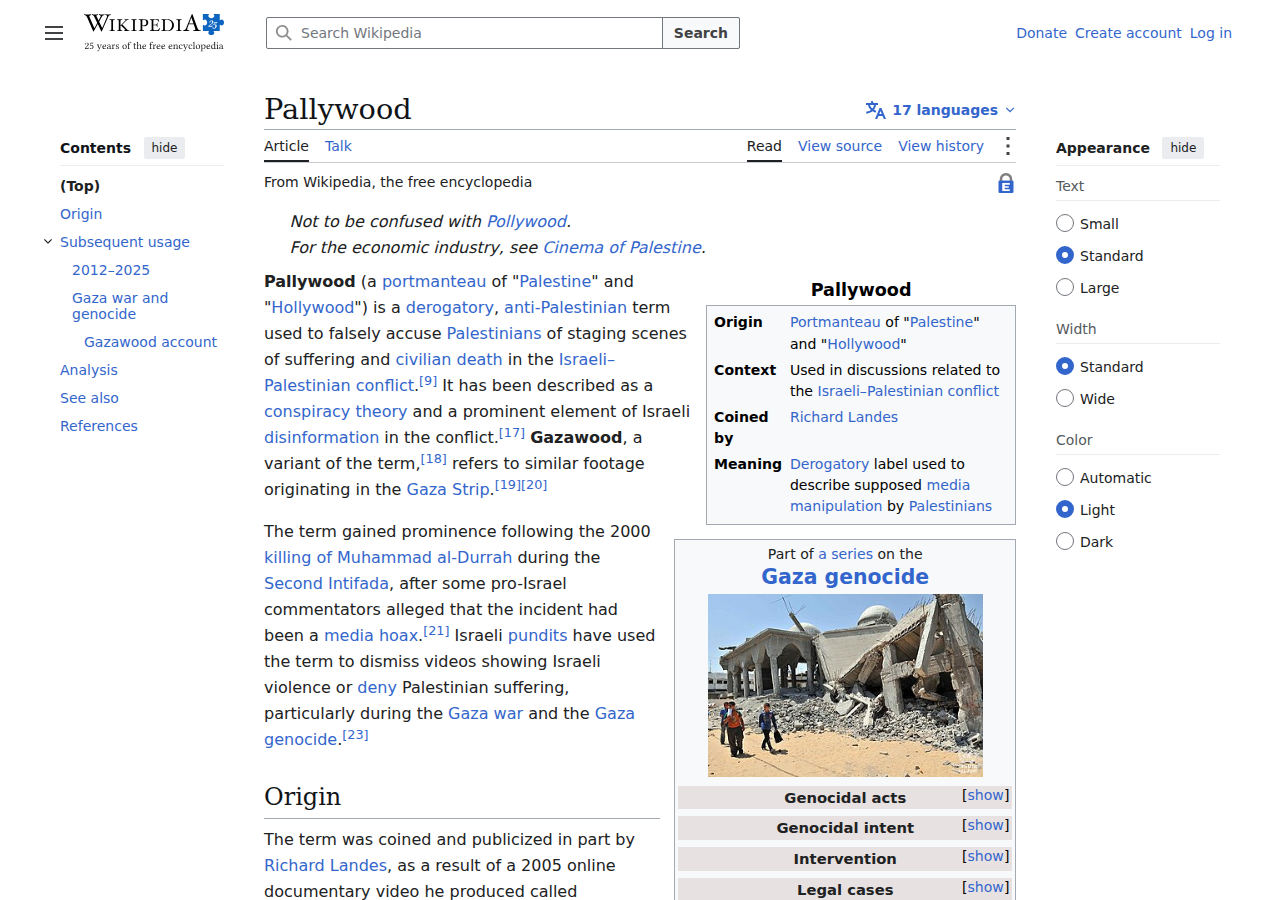
None of this implies that all Gaza suffering is fabricated — it is not. The term "Pallywood" is itself contested (Wikipedia describes it as a pejorative used to allege staging), and some viral "staging" accusations against Gaza footage have themselves proved false — so each case needs its own evidence. The civilian death toll in Gaza is large and documented by multiple independent bodies. The point of documenting Gazawood material is precisely to preserve credibility: when fabricated or staged footage is treated as real, it poisons the evidentiary record and makes it harder to assess genuine claims.
The GAZAWOOD1 Documentation Archive
Resource
The GAZAWOOD1 account on X (Twitter) maintains an ongoing archive of staged and manipulated Gaza footage with side-by-side analysis. It is the primary open-source compilation of this material as of 2024–2025. See also the Richard Landes Pallywood Project at augeanstables.com for historical context and pre-2023 documentation.
Sources & References
- 1. GAZAWOOD1: dedicated account documenting staged Gaza footage (X/Twitter)
- 2. Wikipedia: Pallywood (history of the term, coined by Richard Landes)
- 3. CAMERA: Committee for Accuracy in Middle East Reporting in America; documents media errors
- 4. HonestReporting: tracks and corrects misleading Israel coverage
- 5. Eyal Yakoby: 2015 Syrian refugee image falsely presented as Gazan displacement
- 6. GAZAWOOD1: documented staged mourning scene, Nov 2024