
Where the Trans Movement Came From: Virginia Prince, Autogynephilia, and the Fetish History That Is Not Discussed
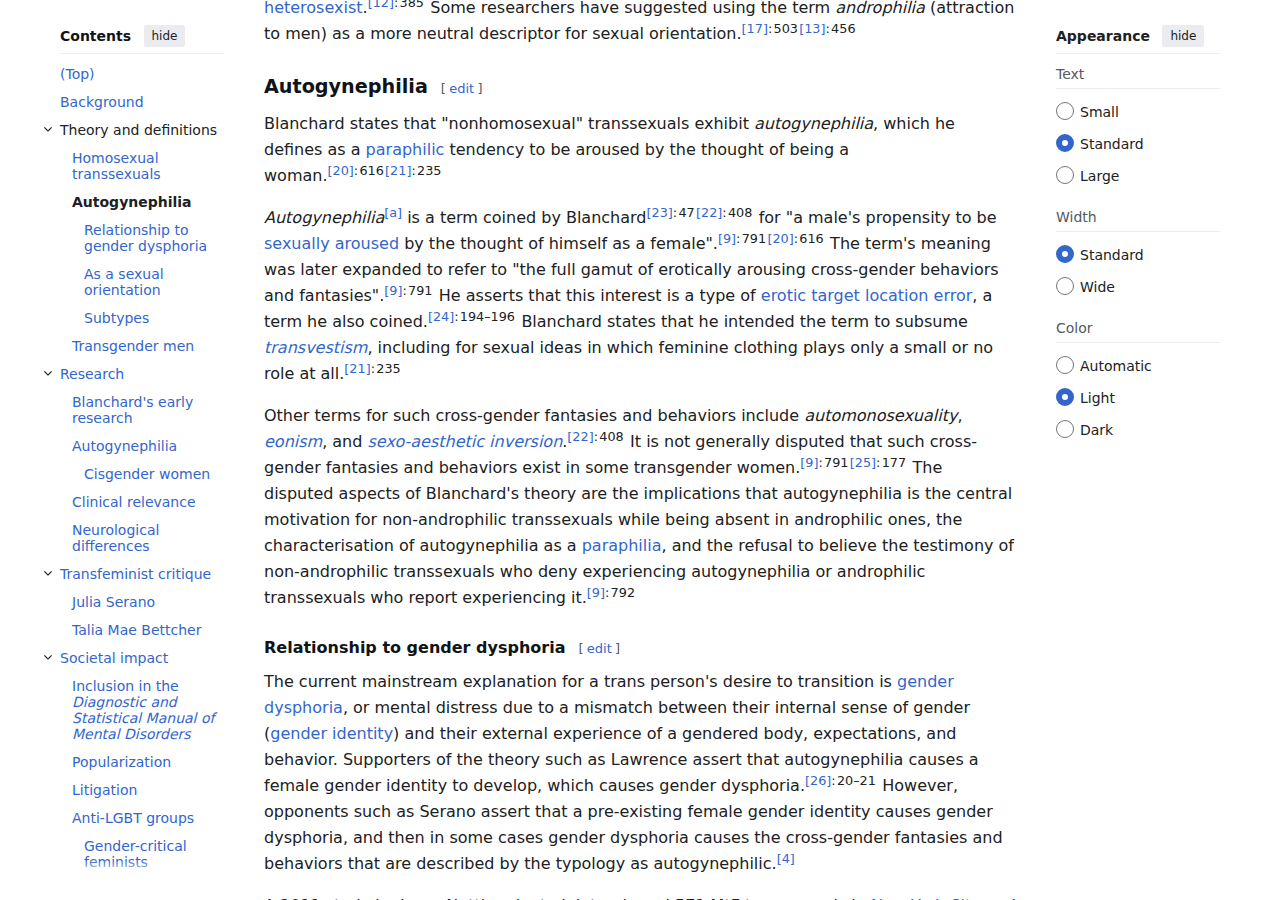
The modern transgender movement was not founded by people with gender dysphoria in the clinical sense. Its primary founders were male cross-dressers who experienced sexual arousal from imagining themselves as women — a phenomenon sexologist Ray Blanchard later named "autogynephilia." Virginia Prince, who invented the word "transgenderism" and founded the first organized transgender community in the US, documented his own sexual motivation in his writings. Contemporary trans-identified writers including Andrea Long Chu have described the same motivation in their own words. This history does not invalidate trans identities, but it does inform the question of where the ideology originated and why it evolved as it did.
Understanding where the contemporary trans movement came from requires engaging with primary sources that are rarely cited in mainstream coverage of trans issues — because those primary sources reveal that the movement's origins are substantially different from the clinical picture of gender dysphoria that is used to justify current policies.
Virginia Prince: The Founder
Virginia Prince (born Arnold Lowman, 1912–2009) is one of the most important founding figures of the trans movement in the United States. Prince:
- Founded the magazine Transvestia in 1960 — the first national publication for cross-dressers
- Founded the Hose and Heels Club, which became Tri-Ess (The Society for the Second Self) — the first organized support network for heterosexual cross-dressers
- Is credited with coining the word 'transgenderism' (1969) as distinct from 'transsexualism' (wanting surgery) and 'transvestism' (cross-dressing)
- Was a heterosexual man who dressed as a woman and called his female self 'Virginia'
In his own published writings, Prince described the erotic element of cross-dressing explicitly. Genevieve Gluck, who researches the history of sexology and trans ideology, documents from primary sources that Prince described experiencing erections while imagining himself as a girl — connecting the practice directly to sexual arousal rather than clinical gender dysphoria.
Prince specifically did not want surgery and criticized those who did. His organizational framework was built for heterosexual cross-dressers — men with wives, professional careers, and conventional lives who dressed as women for erotic satisfaction and adopted female alter-egos. This is the organization that 'transgender' as a political and social category grew from.
Ray Blanchard's Typology and Autogynephilia
In the 1980s and 1990s, sexologist Ray Blanchard at the Clarke Institute of Psychiatry in Toronto conducted extensive research on male-to-female transsexuals. Based on clinical interviews and assessments of hundreds of patients, he developed a two-type typology:
Type 1 — Homosexual transsexuals (HSTS): Natal males who are exclusively attracted to males. They present as female specifically to attract heterosexual men as partners. They typically transition young, pass well as women due to feminine presentation from childhood, and are rarely interested in lesbian relationships as trans-identified women. They report little to no sexual arousal from cross-dressing itself.
Type 2 — Autogynephilic transsexuals (AGP): Natal males who are attracted to females. They experience sexual arousal from the image or thought of themselves as female — what Blanchard termed autogynephilia (Greek: love of oneself as a woman). They typically come out later in life (30s–50s), often after marriages to women, careers, and children. They frequently report fetishistic cross-dressing histories and are often interested in relationships with other women as trans-identified lesbian women.
Blanchard's research was published in peer-reviewed journals including the Archives of Sexual Behavior and the Journal of Sex Research. It was included in the DSM-IV in modified form. It was subsequently removed from the DSM-5 following extensive lobbying from trans advocacy organizations.
The typology is contested by trans advocates, primarily because it situates a sexual motivation at the origin of trans identity for a significant proportion of trans-identified males. But the research basis for the typology is documented; the arguments against it are largely political rather than empirical.
Trans-Identified Writers Describing Their Own Motivation
Remarkably, several prominent trans-identified writers have publicly described motivations consistent with autogynephilia in their own words:
Andrea Long Chu is an influential trans writer whose work Females (2019) is widely assigned in gender studies courses and whose essays appear in the New York Times, n+1, and other prestige publications. Chu has written:
'I transitioned for gossip and compliments, to be checked out, to get a grabbier word for the thing I felt, which wasn't dysphoria so much as an abiding, ever-present and unsuppressable desire to be a woman... Sissy porn did make me trans. I don't know how else to say it.'
This quote is documented and verifiable from Chu's own essays. It explicitly describes sexual content as causal to gender identity — the autogynephilic mechanism Blanchard described clinically, stated in the first person by a prominent trans intellectual.
Julia Serano, a trans-identified biologist and one of the most widely cited pro-trans academic writers, wrote extensively about the psychology of cross-dressing and specifically about 'forced feminization' fantasies in the Archives of Sexual Behavior. Serano argues against the autogynephilia theory from a pro-trans perspective, but in doing so confirms the existence of the phenomenology — males experiencing sexual arousal from imagining or presenting as female — that Blanchard documented. The pro-trans critique of Blanchard's typology is not that the experiences he described don't exist, but that he misinterpreted their meaning.
Why This History Matters for Current Policy
This history does not mean that all trans-identified people have fetishistic motivations. The clinical picture is complex, the HSTS population represents a different presentation, and trans identity clearly exists in people for whom sexual arousal is not the primary driver.
But the history does matter for understanding:
-
Why the movement's founders prioritized access to female spaces specifically: If autogynephilia is a real motivating factor for a significant proportion of trans-identified males, the specific political demands of the movement — access to women's changing rooms, bathrooms, sports, and prisons — take on a different meaning than they do when the entire movement is framed as clinical gender dysphoria.
-
Why women's organizations and feminists were among the earliest opponents: The women who first raised concerns about trans-identified men in female spaces were largely feminist academics and advocates who encountered the movement's origins directly and were not persuaded by the reframing of a cross-dressing community as a civil rights movement.
-
Why the typology was removed from the DSM-5: The political pressure to remove autogynephilia from diagnostic frameworks — rather than the strength of the empirical arguments against it — illustrates how trans advocacy has operated within scientific and medical institutions.
-
Why 'listen to trans people' is insufficient as a political argument: The trans people whose voices are most amplified in mainstream culture are not representative of the full clinical population. Those who describe autogynephilic motivations, or who have detransitioned, or who are critical of current policy, are systematically excluded from the voices that mainstream institutions 'listen to.'
Sources & References
- 1. Genevieve Gluck: Virginia Prince — the man who popularized "transgender" described erections imagining himself as a "girl." Rating 2 (real historical quote)
- 2. Genevieve Gluck: Julia Serano on forced feminization as fetish. Rating 1 (verified quote from Serano)
- 3. ystrïya: Andrea Long Chu — "sissy porn made me trans." Rating 1 (verified quote)
- 4. Genevieve Gluck: Paraphilias overlap and are more common in men. Rating 2 (research supports)
- 5. Ray Blanchard, "Autogynephilia and the Taxonomy of Male-to-Female Transsexualism" (Archives of Sexual Behavior, 2005)
- 6. Andrea Long Chu, "Females" (2019): Seminal pro-trans text documenting autogynephilic origins
- 7. Andrea Long Chu, "My New Vagina Won't Make Me Happy" (NYT, 2018)